

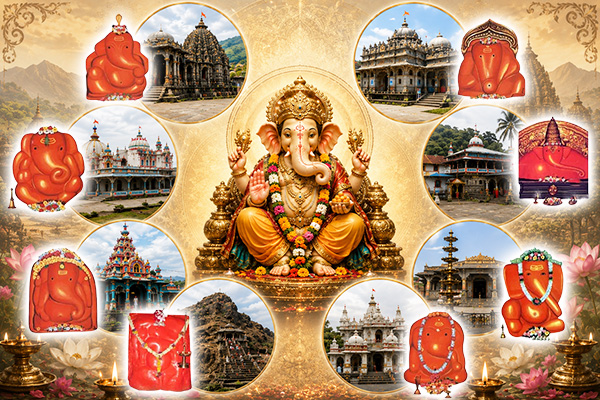
Ashtavinayaka refers to the eight sacred temples of Bhagwan Ganesha situated in Maharashtra, each representing a unique form and legend of the deity. These temples are spread across Pune, Raigad, and Ahmednagar districts, and are central to the Ashtavinayaka Yatra, a pilgrimage believed to fulfill both spiritual and material aspirations. Each Ganesha idol in these temples is distinct, with differences in trunk direction, posture, and features, and every temple holds its own historical significance and legendary tale.
Visiting all eight Ashtavinayaka temples is regarded as highly auspicious, with each temple offering a distinct spiritual experience and blessing, making the pilgrimage a cherished tradition for devotees seeking unity, success, and the removal of obstacles.
Here are the eight Ashtavinayaka Temples of Maharashtra, each with its significance, legend, and unique features:
Moreshwar Temple, Morgaon (Pune)
.jpg)
Significance: Considered the first and most important temple in the Ashtavinayaka circuit, the yatra is traditionally begun and completed here.
Legend: Associated with Bhagwan Ganesha’s victory over the demon Sindhu, arriving on a peacock, hence the name Moreshwar (Mora means peacock).
Unique Features: The idol’s trunk turns left. The temple is surrounded by a large stone wall with four gates, resembling a fort. Nandi, Shiva’s bull, is unusually present here.
Siddhivinayak Temple, Siddhatek (Ahmednagar)
.jpg)
Significance: The only Ashtavinayaka temple where devotees can touch the idol.
Legend: Bhagwan Vishnu worshipped Ganesha here before slaying the demons Madhu and Kaitabh, succeeding with Ganesha’s blessings.
Unique Features: The idol faces north with its trunk curved to the right, considered especially powerful. Located on the banks of the Bhima River. Sage Vyas is believed to have performed penance here.
Ballaleshwar Temple, Pali (Raigad)
.jpg)
Significance: The only Ganesha temple named after a devotee, Ballal, noted for his unwavering devotion.
Legend: When Ballal’s father tried to stop his worship, Ganesha appeared to protect Ballal, granting him darshan and blessing him with a temple in his name.
Unique Features: The idol has diamond-studded eyes. Sun rays fall directly on the deity during the winter solstice. The temple faces east, symbolizing auspiciousness.
Varadavinayak Temple, Mahad (Raigad)
.jpg)
Significance: Known as the giver of boons, this temple is believed to grant wishes to devotees.
Legend:
Linked to Prince Rukmaganda, who was cured of leprosy after praying here.
Unique Features:
Devotees can enter the sanctum and touch the idol. The temple houses a self-manifested (Swayambhu) idol.
Chintamani Temple, Theur (Pune)
.jpg)
Significance: Renowned for relieving worries and granting peace, as “Chinta” means worry and “Mani” means gem.
Legend: Ganesha retrieved the Chintamani gem from King Guna for Sage Kapila, who then gifted it to Ganesha, prompting him to stay at Theur.
Unique Features: The idol’s trunk is turned left, signifying calmness. The temple is associated with the Peshwa rulers and is near the confluence of the Mula, Mutha, and Bhima rivers.
Girijatmaj Temple, Lenyadri (Pune)
.jpg)
Significance: The only Ashtavinayaka temple located on a mountain inside a cave.
Legend: Parvati performed penance here to be blessed with Ganesha as her son, who was born at Lenyadri and called Girijatmaj.
Unique Features: The idol is carved into the rock face and cannot be moved. The temple is inside a Buddhist cave, reached by climbing 307 steps.
Vighnahar Temple, Ozar (Pune)
.jpg)
Significance: Highlights Ganesha as the remover of obstacles, known as Vighnahar.
Legend: Ganesha defeated the demon Vighnasura, who created obstacles in rituals. After his defeat, the demon asked Ganesha to take his name.
Unique Features: The temple has fort-like walls. The idol’s forehead is diamond-studded. Situated near the Kukadi River, enhancing its scenic beauty.
Mahaganpati Temple, Ranjangaon (Pune)
.jpg)
Significance: Depicts Ganesha in his most powerful form, Mahaganpati, invoked by Shiva before battling Tripurasura.
Legend: Bhagwan Shiva called upon Ganesha’s powerful form at this site before his battle.
Unique Features: The idol is described in legend as having ten trunks and twenty arms (the visible idol is more modest). The original idol is believed to be hidden in a basement and shown only on special occasions. The temple faces east, symbolizing new beginnings.
These eight temples each offer a unique spiritual experience, with distinct legends and features, forming a sacred pilgrimage circuit for devotees seeking blessings, peace, and fulfillment.
-in-Astrology.jpg)
.jpg)


shridhar dalavi
|August 22, 2024
Looing for asht Vinayak tours
J Sreenivasaulu
|July 3, 2024
Is it possible to cover all 8temples of asta Ganapathi in one day