

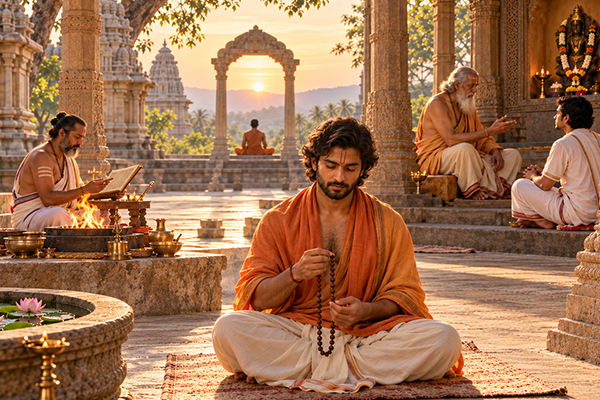
Understanding sacred sound, japa, Guru, initiation, disciplined practice and the Divine Name of Bhagwan
Mantra is one of the oldest and most enduring forms of spiritual practice in Sanatana Dharma. Yet the word mantra does not refer to one single type of practice. The Vedas preserve revealed mantras used in recitation, yajna, prayer and contemplation. The Upanishads use sacred sound as a means of inquiry and meditation upon Brahman. Smarta, Puranic, Agamic and Tantric traditions preserve Devata mantras, bija mantras, nyasa, japa, diksha and Purashcharana in their own detailed ways. Nama Japa turns the mind repeatedly toward Bhagwan through the Divine Name.
A clear understanding therefore begins by respecting these differences. A Vedic mantra should not be treated exactly like a Puranic stotra. A freely recited Divine Name should not automatically be treated like an initiated Tantric mantra. A mantra received through Guru-parampara should be practiced according to that lineage. Advaita Vedanta provides a larger philosophical framework in which worship, japa and meditation have an honored place, while the final teaching points to the non-dual reality of Atman and Brahman.
Chandogya Upanishad 6.2.1
सदेव सोम्येदमग्र आसीदेकमेवाद्वितीयम् ।
Meaning: In the beginning, dear one, Existence alone was, one without a second.
Contents
- The Vedic and Advaita foundation: Brahman, Ishvara, Bhagwan and Devata
- What mantra means in different Hindu traditions
- The main types of mantra and how their rules differ
- Om or Pranava in the Upanishads and Advaita Vedanta
- The Savitri and Tryambaka mantras as Vedic examples
- Japa and Nama Japa: repetition, remembrance and inwardness
- Guru and Diksha: Vedic teaching and mantra initiation
- Purashcharana: its meaning, purpose and traditional limbs
- Discipline in mantra-sadhana
- Advaita Vedanta: from upasana to Brahma-jnana
- A practical guide to approaching mantra practice correctly
- Scriptural references used in this guide
1. The Vedic and Advaita Foundation
Advaita Vedanta begins with Brahman, the limitless reality that is not divided into competing absolutes. The Upanishads repeatedly declare that the essence of the individual and the essence of the whole are not ultimately separate. At the same time, Advaita fully accommodates the lived religious world of Ishvara, Bhagwan, Devatas, puja, mantra, pilgrimage, vrata and devotion. These are not dismissed as meaningless. They belong to the sacred life through which the mind becomes steady, reverent, refined and prepared for knowledge.
For a new reader, the simplest way to understand this is that Advaita does not ask a devotee to stop worshipping Bhagwan. It asks the seeker to understand more deeply what Bhagwan, the world and the Self ultimately are. For an experienced practitioner, this means that the path of upasana and the path of knowledge must be related correctly rather than confused with one another.
Chandogya Upanishad 3.14.1
सर्वं खल्विदं ब्रह्म तज्जलानिति शान्त उपासीत ।
Meaning: All this indeed is Brahman. With this understanding, one should meditate with a calm and collected mind.
This statement does not erase the practical distinctions of daily life. Rather, it gives them a deeper ground. The world of names, forms, worship and action is experienced, honored and lived, while Vedanta asks the seeker to discover the one reality because of which all experience is possible.
Brahman, Ishvara and Bhagwan
In Advaita, Brahman is the ultimate reality. When that same reality is understood as the intelligent order, source and Lord of the universe, the language of Ishvara or Bhagwan is used. The distinction is not between two separate ultimate beings. It is a difference of standpoint. The devotee approaches Bhagwan through name, form, worship and surrender; Vedanta later reveals that the consciousness by which the devotee knows every experience is not separate from Brahman.
The terms Saguna Brahman and Nirguna Brahman are therefore not meant to create two Brahmans. Saguna refers to Brahman as understood with attributes and as the Lord who can be worshipped. Nirguna refers to Brahman free from every limiting description. Upasana generally begins with a sacred support such as a Devata, mantra or form. Brahma-jnana concerns the reality that is never confined to any one support.
Many Devatas within one sacred vision
Rigveda 1.164.46
इन्द्रं मित्रं वरुणमग्निमाहुरथो दिव्यः स सुपर्णो गरुत्मान् ।
एकं सद्विप्रा बहुधा वदन्त्यग्निं यमं मातरिश्वानमाहुः ॥Meaning: The seers speak of the One Reality in many ways, using names such as Indra, Mitra, Varuna, Agni, Yama and Matarishvan.
This famous Vedic verse is often used to express the breadth of the Vedic vision. It should not be read carelessly as though every Devata, mantra and ritual were interchangeable. Each Devata has a distinct liturgical identity and each mantra belongs to a specific textual and ritual setting. The broader point is that the Vedic tradition can honor many sacred names without requiring many independent ultimate realities.
2. What Is a Mantra?
In ordinary modern usage, mantra can mean almost any sacred phrase. Traditional usage is more precise. In the Vedic setting, a mantra is a sacred utterance of Shruti preserved through recitation and used in yajna, invocation, praise, prayer or contemplation. In later Smarta, Puranic, Agamic and Tantric traditions, mantra also refers to sacred formulas associated with a particular Devata and method of sadhana.
A mantra is therefore not merely a sentence with a spiritual meaning. Its sound, textual source, Devata, manner of recitation and traditional use can all be important. Some mantras are public and widely recited. Some are bound to a formal ritual context. Some are transmitted through Diksha. Some include bija syllables, nyasa, mudra, yantra and a prescribed Purashcharana. The correct practice depends on what kind of mantra it is.
Why pronunciation matters in Vedic recitation
Taittiriya Upanishad 1.2.1
ॐ शीक्षां व्याख्यास्यामः । वर्णः स्वरः । मात्रा बलम् । साम सन्तानः । इत्युक्तः शीक्षाध्यायः ॥
Meaning: We shall explain phonetics: sound, accent, duration, force, modulation and continuity. Thus is the teaching on proper recitation.
The Vedic tradition preserves not only words but a disciplined method of sounding them. Varna concerns the sound itself; svara concerns accent; matra concerns duration; bala concerns the force of articulation; and the remaining elements concern the continuity and musical pattern of recitation. This is why Vedic mantras with svara are ideally learned from a trained teacher rather than reconstructed only from an English spelling or an online transliteration.
For a beginner, this does not mean that spiritual practice is inaccessible. It simply means that one should know what one is practicing. A simple prayer, Nama Japa and a formal Vedic recitation are not the same exercise and should not be presented as though they are governed by identical rules.
3. Main Types of Mantra
Hindu traditions use several overlapping classifications of mantra. No single chart can replace the classification used by a particular Shastra or lineage, but the following structure is useful because it keeps major categories clear for both new readers and experienced practitioners.
| Type | What it is | How it is generally approached |
|---|---|---|
| Vedic mantra | A mantra belonging to Shruti and preserved in a Vedic shakha. | Textual accuracy, Vedic pronunciation and the proper ritual or contemplative context are important. |
| Om or Pranava | The sacred syllable given a special place in the Upanishads and Yoga tradition. | Used in Vedic recitation, contemplation and meditation. In Advaita it is a major support for inquiry into Atman and Brahman. |
| Savitri, popularly called Gayatri | Rigveda 3.62.10, addressed to Savitr and composed in Gayatri meter. | Traditionally approached within Vedic and Sandhya practice. Its famous liturgical form is larger than the Rigvedic verse alone. |
| Nama Japa | Repetition of the Divine Name of Bhagwan. | Used for remembrance, devotion and concentration. A simple Divine Name is distinct from a formal mantra containing bija or lineage-specific ritual requirements. |
| Smarta and Puranic mantra | Sacred formulas used in puja, vrata, stotra and domestic worship. | The source text, Devata and family or sampradaya tradition guide the practice. |
| Agamic or Tantric mantra | Mantras taught in Shaiva, Shakta, Vaishnava and other Agamic or Tantric systems. | May require Diksha and may include bija, nyasa, mudra, dhyana, yantra, homa and Purashcharana. |
| Bija mantra | A seed syllable associated with a Devata, tattva or Shakti in mantra-shastra. | Should be understood in the ritual system from which it comes rather than treated as a generic sound detached from source and method. |
Gayatri is first the name of a Vedic meter
The expression Gayatri Mantra is commonly used for the famous Savitri mantra of Rigveda 3.62.10. Strictly speaking, Gayatri is the meter in which that verse is composed, while Savitr is its Devata. Later Hindu traditions also preserve many Devata-specific Gayatri-style mantras. These later formulas should be identified by their own textual source rather than assumed to be verses of the Rigveda.
Bija mantras need context
Seed syllables such as Hrim, Shrim, Klim, Aim, Krim and Gam are important in later mantra-shastra, especially in Agamic and Tantric sadhana. Their meaning is not exhausted by a one-line dictionary definition. They function within a larger ritual and contemplative system that may include Devata-dhyana, nyasa, yantra, mudra and Guru instruction. Om is sometimes grouped with bija syllables in later usage, but the Upanishads give Pranava an independent and especially important Vedantic status.
4. Om or Pranava in the Upanishads
Om is central to Vedic recitation and receives profound treatment in the Upanishads. Advaita Vedanta does not treat Om merely as a sound believed to produce a result by repetition. It is also a teaching symbol. Through Om, the seeker is led to contemplate the totality of experience and the reality of the Self.
Taittiriya Upanishad 1.8.1
ओम् इति ब्रह्म । ओम् इतीदं सर्वम् ।
Meaning: Om is Brahman. Om is all this.
Mandukya Upanishad 1
ओमित्येतदक्षरमिदं सर्वम् । तस्योपव्याख्यानं भूतं भवद् भविष्यदिति सर्वमोङ्कार एव । यच्चान्यत् त्रिकालातीतं तदप्योङ्कार एव ॥
Meaning: Om, this syllable, is all this. The past, present and future are Om, and what is beyond the three divisions of time is also Om.
Mandukya Upanishad 2
सर्वं ह्येतद् ब्रह्म । अयमात्मा ब्रह्म । सोऽयमात्मा चतुष्पात् ॥
Meaning: All this is Brahman. This Atman is Brahman.
The Mandukya Upanishad proceeds to analyze waking, dream, deep sleep and the reality called Turiya. The purpose is not merely to praise a sacred syllable. Om becomes a compact teaching through which the seeker examines the entire range of experience and recognizes that consciousness, the Self, is not limited to any one state.
Mundaka Upanishad 2.2.4
प्रणवो धनुः शरो ह्यात्मा ब्रह्म तल्लक्ष्यमुच्यते ।
अप्रमत्तेन वेद्धव्यं शरवत्तन्मयो भवेत् ॥Meaning: Pranava is the bow, the Self is the arrow, and Brahman is said to be the target. With an undistracted mind it is to be known, as an arrow reaches its mark.
This imagery joins sacred sound with attention and knowledge. The bow is useful only when it is directed. In the same way, repetition becomes spiritually meaningful when the mind is brought to the meaning, the Devata or the truth indicated by the mantra.
Patanjali Yoga Sutra 1.27-1.28
तस्य वाचकः प्रणवः ॥
तज्जपस्तदर्थभावनम् ॥Meaning: Pranava is the expression of Ishvara. Its japa is to be accompanied by contemplation of its meaning.
5. Two Important Vedic Mantras
Two mantras that are widely known today are the Savitri and the Tryambaka mantra. Both are Vedic, but their later ritual and devotional lives are much larger than the original Rigvedic verses. Understanding both layers increases reverence rather than reducing it.
The Savitri Mantra
Rigveda 3.62.10
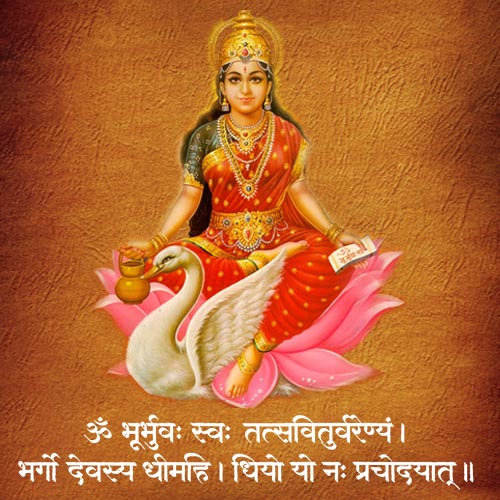
तत्सवितुर्वरेण्यं भर्गो देवस्य धीमहि ।
धियो यो नः प्रचोदयात् ॥Meaning: We meditate upon the excellent radiance of the divine Savitr. May that radiance inspire and illumine our understanding.
The mantra is addressed to Savitr, the Vedic divine power associated with impelling, awakening and setting into motion. Its central prayer concerns dhi, the faculty of understanding and insight. This is why the mantra has such a strong contemplative character. In common practice it is called the Gayatri Mantra because the Rigvedic verse is composed in Gayatri meter.
The familiar Sandhya recitation often places Om and the three great utterances, Bhur, Bhuvah and Svah, before the Savitri verse. It is useful to know this distinction: the core Rigvedic verse is Rigveda 3.62.10, while the liturgical recitation surrounding it belongs to the wider tradition of Vedic practice.
The Tryambaka Mantra
Rigveda 7.59.12
त्र्यम्बकं यजामहे सुगन्धिं पुष्टिवर्धनम् ।
उर्वारुकमिव बन्धनान्मृत्योर्मुक्षीय मामृतात् ॥Meaning: We worship Tryambaka, fragrant and increasing nourishment. Like a ripe fruit released from its bond, may I be released from death, not from immortality.
The verse occurs in the Rigveda and is associated with Rudra. In later Shaiva practice it is widely known as the Mahamrityunjaya Mantra and Tryambaka is commonly understood in relation to the three-eyed form of Shiva. The prayer is powerful because it does not simply ask for the denial of mortality; it asks for release from the bondage of death without separation from immortality.
This distinction between the Vedic verse and its later devotional name is useful for serious readers. The later Shaiva understanding is an honored part of tradition, while the Rigvedic source remains clear and intact.
6. Japa and the Divine Name of Bhagwan
Japa is the repeated recitation of a mantra or sacred name with attention. It is one of the most accessible ways of gathering the mind because it gives the mind a sacred center. Japa may be performed as part of Vedic practice, Puranic worship, mantra-sadhana, Yoga or devotional remembrance. The method depends upon the mantra being repeated.
Bhagavad Gita 10.25
महर्षीणां भृगुरहं गिरामस्म्येकमक्षरम् ।
यज्ञानां जपयज्ञोऽस्मि स्थावराणां हिमालयः ॥Meaning: Among the great seers I am Bhrigu; among utterances I am the single syllable Om; among yajnas I am Japa-yajna; among immovable things I am the Himalaya.
The Gita places japa among the sacred forms of yajna. This gives japa a broad place in spiritual life without restricting it to one sectarian formula. The important question is always what is being repeated and how that practice is traditionally governed.
Three modes of japa
Traditional texts commonly distinguish three modes of japa. Vacika is audible recitation. Upamshu is very soft recitation, where the lips move and the sound is barely heard. Manasa is mental repetition. The movement from audible to mental japa is a movement toward inwardness, but mental japa is not automatically superior if attention is absent. The quality of awareness remains essential.
Manusmriti 2.85
विधियज्ञाज्जपयज्ञो विशिष्टो दशभिर्गुणैः ।
उपांशुः स्याच्छतगुणः साहस्रो मानसः स्मृतः ॥Meaning: The text praises japa above outward ritual and gives progressively greater value to subtle and mental recitation.
What is Nama Japa?
Nama Japa is the repetition of the Divine Name of Bhagwan. Depending on one’s tradition, the name may be Shiva, Rama, Narayana, Krishna, Devi, Ganesha, Surya or another revered name. In a Vedic and Advaita presentation, the purpose is not to declare one sacred name invalid because another is preferred. The practitioner turns the mind repeatedly toward Bhagwan through the chosen Divine Name with reverence, steadiness and remembrance.
A simple Divine Name and a formal initiated mantra must still be distinguished. A name can be remembered devotionally, while a lineage mantra may contain bija, specific syllabic structure, nyasa, a fixed count, a particular dhyana or a formal Purashcharana. Once a mantra is received through Diksha, the discipline attached to that mantra should be honored.
Bhagavad Gita 8.7
तस्मात्सर्वेषु कालेषु मामनुस्मर युध्य च ।
मय्यर्पितमनोबुद्धिर्मामेवैष्यस्यसंशयम् ॥Meaning: Therefore remember Me at all times and perform your duty. With mind and understanding offered to Me, you shall come to Me without doubt.
The key principle is remembrance joined with life. Spiritual practice is not meant to become an escape from dharma. The Gita joins remembrance with action: remember Bhagwan and perform the duty that stands before you.
7. Guru and Diksha
The word Guru is sometimes reduced either to a ceremonial title or to an unquestionable personality. The Upanishadic understanding is more demanding. A Guru is a teacher capable of revealing the meaning of the Shastra, especially the knowledge of Brahman. In mantra traditions, a Guru may also transmit a particular mantra and the discipline required for its practice.
Mundaka Upanishad 1.2.12
परीक्ष्य लोकान्कर्मचितान्ब्राह्मणो निर्वेदमायान्नास्त्यकृतः कृतेन ।
तद्विज्ञानार्थं स गुरुमेवाभिगच्छेत्समित्पाणिः श्रोत्रियं ब्रह्मनिष्ठम् ॥Meaning: Having examined the results produced by action and understood that the uncreated cannot be produced by action, the mature seeker should approach a Guru who is learned in the Veda and established in Brahman.
Two qualifications are especially important in this Upanishadic description. Shrotriya means one who is grounded in the teaching tradition and knows how the Shastra unfolds its meaning. Brahmanishtha means one who is established in the knowledge of Brahman. Vedanta therefore values both scriptural competence and realization.
Bhagavad Gita 4.34
तद्विद्धि प्रणिपातेन परिप्रश्नेन सेवया ।
उपदेक्ष्यन्ति ते ज्ञानं ज्ञानिनस्तत्त्वदर्शिनः ॥Meaning: Know this through reverence, sincere inquiry and service. Those who know and see the truth will teach you that knowledge.
The Gita includes inquiry, not blind submission. Pranipata expresses humility, pariprashna means thoughtful and repeated inquiry, and seva expresses the discipline of serving the teaching relationship. A mature Guru-disciple relationship therefore contains reverence, questioning, learning and practice.
What does Diksha mean?
Diksha has more than one traditional use. In the Vedic ritual world, Diksha can mean the consecration by which a yajamana enters a sacrificial discipline. In later Agamic and Tantric mantra systems, mantra-Diksha means formal initiation into a mantra, Devata and method of practice. The common idea is consecrated entry into a disciplined sacred undertaking, but the procedures are not identical.
A mantra-Diksha may include the transmission of the mantra, its correct pronunciation, the identity and contemplation of the Devata, nyasa, japa method, daily observances, restrictions, worship procedure and the relationship of the mantra to the lineage. Some traditions regard Diksha as essential for specific mantras, especially those embedded in Agamic or Tantric ritual systems.
It is therefore inaccurate to make either extreme claim that every sacred utterance requires formal mantra-Diksha, or that no mantra ever requires initiation. The source of the mantra and the rules of the tradition determine the answer.
8. What Is Purashcharana?
Purashcharana is a formal discipline undertaken to establish a mantra-sadhana according to a specific Shastra or lineage. It is not simply a large number of repetitions. Japa is central, but traditional Purashcharana joins japa with worship, offering and disciplined conduct so that the practitioner’s whole life supports the mantra.
Brahmanda Purana, Lalitopakhyana 3.41.30
पूजा त्रैकालिकी नित्यं जपस्तर्पणमेव च ।
होमो ब्राह्मणभुक्तिश्च पुरश्चरणमुच्यते ॥Meaning: Regular worship, japa, tarpana, homa and feeding of Brahmanas are called Purashcharana.
This verse presents a five-limbed form of Purashcharana. Other mantra texts and lineages may arrange or count the limbs differently, but the central point remains: Purashcharana is an integrated discipline, not only a numerical target.
| Limb | Meaning | Purpose within the discipline |
|---|---|---|
| Puja | Regular worship of the Devata | Establishes reverence, invocation, offering and meditative relationship with the Devata of the mantra. |
| Japa | Repeated recitation of the mantra | Forms the central current of the practice. The required count is determined by the mantra and its Shastric prescription. |
| Tarpana | Ritual offering, commonly with water or another prescribed substance | Expresses offering and satisfaction according to the specific ritual method. |
| Homa | Offering into sacred fire while reciting the mantra | Extends the mantra into yajna through Agni and the prescribed offerings. |
| Brahmana-bhojana | Feeding Brahmanas as prescribed | Forms part of the traditional completion of the discipline in texts that prescribe this fivefold pattern. |
Does every mantra require Purashcharana?
No single answer applies to every mantra. Some mantras are practiced as part of a formal system that prescribes Purashcharana. Some are recited within daily puja or Sandhya. Some Divine Names are remembered through Nama Japa without a formal Purashcharana. Some mantras received through Diksha have exact counts, homa materials and completion rites that must be followed.
For this reason, a practitioner should not copy a Purashcharana count from one mantra and apply it automatically to another. The relevant Shastra, paddhati, sampradaya and Guru determine the correct procedure.
9. Discipline in Mantra-Sadhana
Traditional mantra-sadhana is not based on the idea that sound alone compensates for an undisciplined life. The outer and inner disciplines create conditions in which the mind becomes less scattered and more fit for japa, dhyana and spiritual inquiry. The exact rules differ from one practice to another, but certain principles occur repeatedly across Hindu traditions.
Taittiriya Upanishad 1.11.1
सत्यं वद । धर्मं चर । स्वाध्यायान्मा प्रमदः ।
Meaning: Speak truth. Live according to dharma. Do not neglect study of the sacred teaching.
| Discipline | What it means in practice |
|---|---|
| Shaucha | Cleanliness of body, surroundings and the place of worship, together with the ritual purity required by the specific practice. |
| Satya | Truthfulness in speech and conduct. Japa and deliberate falsehood pull the mind in opposite directions. |
| Ahara-niyama | Regulation of food according to the practice. Some sadhanas prescribe specific foods, fasting rules or restrictions. |
| Indriya-nigraha | Regulation of the senses so that the mind is not continually carried outward by habit and stimulation. |
| Brahmacharya | Discipline of sexual energy and conduct. Some practices prescribe celibacy for a fixed period; others emphasize responsible restraint. |
| Mauna and vak-samyama | Restraint of unnecessary speech. The same faculty used for mantra should not be continually dissipated through gossip, harshness or agitation. |
| Niyama | Regularity in time, place, count, sleep, worship and personal conduct. |
| Svadhyaya | Study of the Shastra and teachings relevant to the mantra, Devata and spiritual goal. |
| Guru-seva and seva | Respectful service to the teaching tradition and selfless service that reduces ego-centeredness. |
Why regularity matters
Japa develops depth through repeated return. The mind wanders, and the discipline is to bring it back without irritation or discouragement. This principle is stated directly in the Gita.
Bhagavad Gita 6.26
यतो यतो निश्चरति मनश्चञ्चलमस्थिरम् ।
ततस्ततो नियम्यैतदात्मन्येव वशं नयेत् ॥Meaning: Whenever the restless and unsteady mind wanders, it should be gently restrained and brought back under the discipline of the Self.
For beginners, this means that distraction is not proof that japa has failed. Returning is the practice. For experienced practitioners, the verse points beyond mere counting: the quality of recollection, steadiness and inwardness matters as much as numerical completion.
Mantra-siddhi and the Vedantic goal
Mantra-shastra may speak of mantra-siddhi, the successful establishment of a mantra and the attainment of results associated with that practice. Advaita Vedanta does not need to deny those categories, but it distinguishes them from moksha. Ritual accomplishment, devotional experience, concentration and even extraordinary abilities are not identical with liberation from ignorance. The final Vedantic concern is knowledge of the Self as Brahman.
10. Advaita Vedanta: From Upasana to Brahma-Jnana
Mantra, japa, puja and Devata-upasana have an honored place in the Advaita path because they help prepare the mind. They can strengthen devotion, steadiness, self-control, concentration and surrender. These qualities are not insignificant. A mind dominated by agitation, craving and habitual identification finds subtle Vedantic inquiry difficult.
At the same time, Advaita makes a precise distinction between preparation and liberating knowledge. Brahman is not produced by a mantra, created by meditation or brought into existence by a ritual. Brahman is the ever-present reality. Sadhana prepares the seeker to understand what the Upanishads reveal.
Upasana, then inquiry
Upasana means deliberate contemplation upon Ishvara, Bhagwan, a Devata or a sacred support. It gathers the mind and refines the inner instrument. Brahma-jnana arises through the Vedantic process of hearing the teaching from a competent Guru, reflecting upon it until doubt is resolved, and assimilating it deeply. These stages are commonly described as shravana, manana and nididhyasana.
The transition from devotion to knowledge is not a rejection of Bhagwan. Rather, the devotee comes to understand the non-separation of the worshipper, the worshipped and the reality because of which both are known. Devotion can therefore mature from a relationship of distance into reverence grounded in non-dual understanding.
Chandogya Upanishad 6.8.7
स य एषोऽणिमैतदात्म्यमिदं सर्वं तत्सत्यं स आत्मा तत्त्वमसि श्वेतकेतो ॥
Meaning: That subtle essence is the Self of all this. That is the Truth. That is the Self. You are That, Shvetaketu.
Tat Tvam Asi does not mean that the ordinary ego, personality or body is the creator of the universe. The teaching reveals the identity of the essential consciousness in the individual with Brahman, once the limiting identifications attached to both expressions are properly understood through the Upanishadic method.
Brihadaranyaka Upanishad 1.4.10
अहं ब्रह्मास्मि ।
Meaning: I am Brahman.
Aham Brahmasmi is likewise not a statement of personal greatness. It is a statement of knowledge in which the limited self-sense is corrected. The word I, when understood as pure consciousness rather than as body, mind, status or personality, is known as non-separate from Brahman.
11. How to Approach Mantra Practice Correctly
The safest and most authentic way to approach mantra is not to ask only, 'How many times should I chant it?' The first question is, 'What kind of mantra is this, and from which tradition does it come?' Once the identity of the mantra is clear, the rules become much easier to understand.
- Identify the source. Determine whether the mantra is Vedic, Puranic, Smarta, Agamic, Tantric, a stotra verse, a Divine Name or a later devotional composition.
- Identify the Devata and purpose. A mantra is easier to practice correctly when its Devata, meaning and traditional use are known.
- Check whether Diksha is prescribed. Do not assume either that every mantra needs formal initiation or that none do.
- Learn pronunciation from the right kind of teacher. Vedic mantras with svara require Vedic instruction. A lineage mantra should be learned in that lineage.
- Keep the prescribed method intact. If a mantra uses nyasa, dhyana, a fixed count, homa or Purashcharana, these are part of its system and should not be casually redesigned.
- Understand the meaning as far as the tradition permits. Japa becomes deeper when sound, attention and sacred meaning support one another.
- Maintain regularity. A modest daily discipline performed steadily is generally more valuable than irregular bursts of enthusiasm.
- Do not measure spiritual progress only by unusual experiences. Greater steadiness, clarity, truthfulness, compassion, restraint and devotion are more dependable signs of inner maturation.
- For Advaita Vedanta, remember the final direction. Mantra and upasana purify and steady the mind; the Upanishadic teaching removes ignorance regarding the Self.
A concise distinction for readers
| Practice | Primary emphasis | Traditional guidance |
|---|---|---|
| Vedic recitation | Preservation of Shruti through exact sound and recitation | Learn the text and svara from a qualified Vedic teacher. |
| Nama Japa | Remembrance of Bhagwan through the Divine Name | Practice with devotion and steadiness; if the name is part of a formal mantra, follow that mantra tradition. |
| Devata mantra | Focused worship and contemplation of a particular form of Bhagwan | Follow the source text, sampradaya and Guru instruction. |
| Bija mantra | Seed formula within mantra-shastra | Avoid separating it from the lineage and ritual context in which it is taught. |
| Purashcharana | Formal establishment of mantra practice through multiple ritual limbs | Perform only according to the prescription for that mantra. |
| Vedantic contemplation | Knowledge of Atman and Brahman | Study the Upanishadic teaching under a competent Guru and assimilate it through reflection. |
12. Scriptural References Used in This Guide
The following passages form the principal scriptural basis of this presentation. They are listed so that readers who wish to study more deeply can return to the original texts and their traditional commentaries.
| Text | Passages used | Subject |
|---|---|---|
| Rigveda | 1.164.46; 3.62.10; 7.59.12 | One Reality spoken of through many divine names; Savitri mantra; Tryambaka mantra. |
| Taittiriya Upanishad | 1.2.1; 1.8.1; 1.11.1 | Vedic phonetics; Om; truth, dharma and study. |
| Chandogya Upanishad | 3.14.1; 6.2.1; 6.8.7 | All this is Brahman; one without a second; Tat Tvam Asi. |
| Brihadaranyaka Upanishad | 1.4.10 | Aham Brahmasmi and the knowledge of the Self as Brahman. |
| Mandukya Upanishad | 1-2 | Om as the totality; Atman is Brahman. |
| Mundaka Upanishad | 1.2.12; 2.2.4 | Approaching a Shrotriya and Brahmanishtha Guru; Pranava as the bow and Brahman as the target. |
| Bhagavad Gita | 4.34; 6.26; 8.7; 10.25 | Guru and inquiry; discipline of the mind; remembrance of Bhagwan; Japa-yajna and Om. |
| Patanjali Yoga Sutra | 1.27-1.28 | Pranava as the expression of Ishvara; japa joined with contemplation of meaning. |
| Manusmriti | 2.85 | Traditional praise of japa and the inward modes of repetition. |
| Brahmanda Purana, Lalitopakhyana | 3.41.30 | Five traditional limbs of Purashcharana. |
The Larger Vision
A mature understanding of mantra does not need to flatten Sanatana Dharma into one method or one sectarian formula. Vedic mantra can remain Vedic. Nama Japa can remain devotional remembrance. Agamic and Tantric mantras can retain their requirements of Diksha and lineage. Purashcharana can be understood in its full ritual sense. Advaita Vedanta can then place these disciplines within a larger movement from dharma and upasana toward knowledge of the non-dual Self.
The purpose of such clarity is not to make spiritual practice complicated. It is to preserve authenticity. When the source, method and goal are understood, reverence becomes more intelligent, practice becomes more stable and the seeker can go deeper without confusing one tradition with another.
Brihadaranyaka Upanishad 1.4.10
अहं ब्रह्मास्मि ।
Meaning: I am Brahman.
Mantra, Diksha & Purashcharana: A Vedic and Advaita Vedanta Guide
-in-Astrology.jpg)
.jpg)


Comments 0
Leave your thought here