

.jpg)
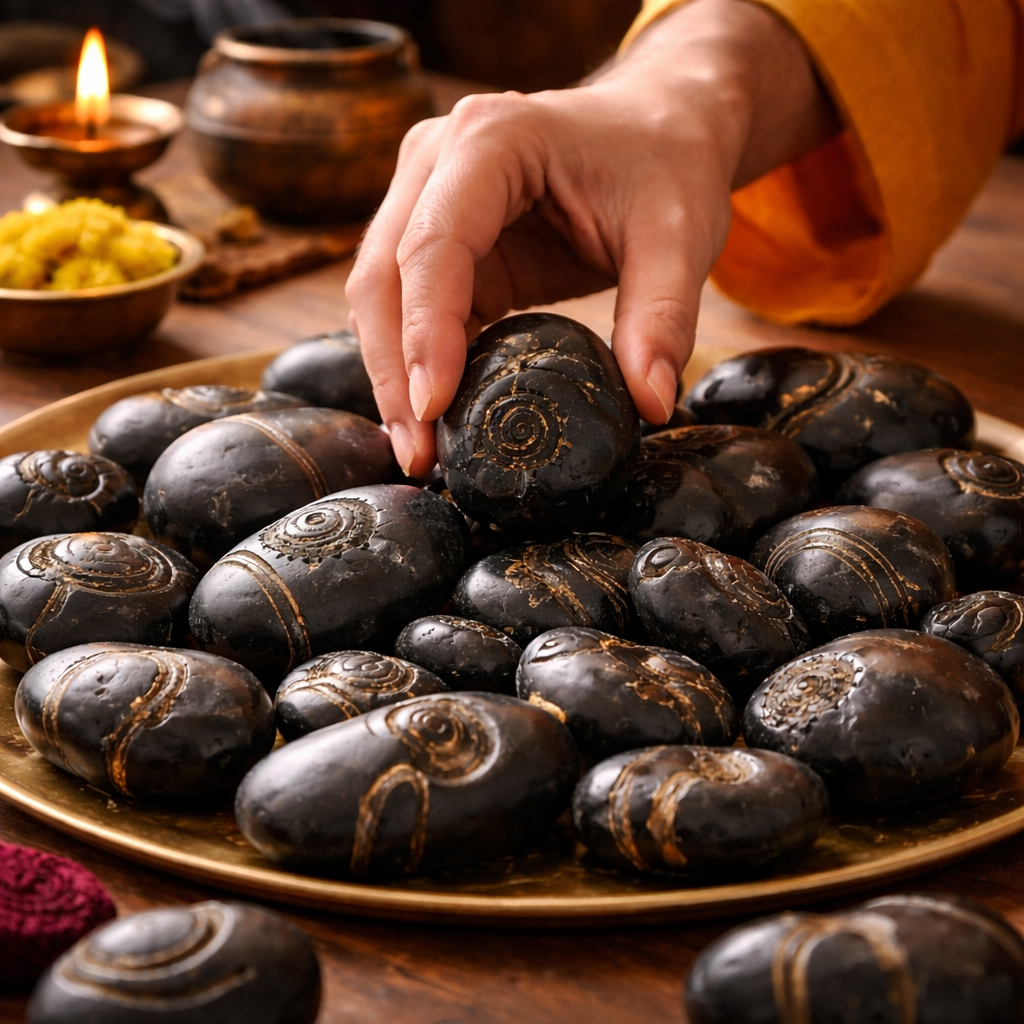
Shaligram Shila is considered Sakshat Lord Vishnu Swaroop and is naturally Jagrut (awakened). Worshipping Shaligram daily with devotion is believed to bring peace, prosperity, positivity, and divine blessings into the home.
Offering Tulsi leaves, water and prayers to Shaligram helps devotees connect deeply with the divine energies of Lord Vishnu and Maa Lakshmi.
Benefits of Shaligram Puja
.jpg)
The Vishnu Swaroopi Shaligrama being Jagrut holds immense energies which can transform the devotee’s life completely. Listed below are a few of the many benefits the Shaligram offers when one devotedly worships it and performs puja every day.
- As mentioned in the Puranas, if a devotee worships the Shaligram Shila with pure devotion regularly, he/she is blessed abundantly. The life of the devotee is filled with happiness, immense prosperity, wealth, success in all undertakings and recognition.
- According to Brahmavaivarta Purana, in the chapter of Prakritikhand, it is mentioned that Lord Vishnu along with consort Goddess Lakshmi reside in the place where Shaligram Shila is worshipped every day, especially during the auspicious day like Ekadashi.
- The Skanda Purana also mentions that any person who worships the Shaligram Shila with pure devotion in the month of Kartik will be blessed by Lord Shiva Himself.
- Worshipping Shaligram offers all the benefits that a person receives by performing various Yagnas and visiting pilgrimages as mentioned in the Vedic Scriptures. Moreover, consuming the water in which a Shaligram Sila is placed keeps all the diseases at bay and washes off all the sins.
- When the Shaligram is worshipped on auspicious occasions like Tulsi Vivah, Ekadashi and during the Holy month of Kartik, the devotee is blessed meritoriously.
There are many such benefits a Shaligram offers when worshipped. Listed below is the detailed puja methodology for performing the Shaligram puja as per Holy Scriptures. Let us first look at the Puja Samagri (articles) followed by the detailed Puja methodology for performing Shaligram puja.
.jpg)
List of Puja Samagri for performing Shaligram Puja
- Lord Shaligram Sila
- Tulsi Leaves
- Tulsi Mala
- Ganga Jal
- Copper Plate
- Kusha Grass
- Cloth
- Conch
- Ghee Lamp
- Janeu, Mauli
- Sandalwood paste
- Panchamrit (mixture of milk, curd, water, honey and ghee)
- Peepal/paan leaves
- Dhoop
- Incense sticks
- Fresh flowers
- Fruits
- Camphor
- Mithai (sweets) for offering at Bhog
Puja Methodology
- Wake up early in the morning
- Cleanse yourself by bathing and wearing fresh clothes
- Now be seated on an asana facing the East or North-East direction
- You can either perform the puja by yourself or appoint a Guru who can perform the Shaligram puja in a Vedic manner
- It is ideal to place only one Shaligram in the house. If you want to install more than one Shaligram, then you may keep an even number starting from 4. The Shaligrams must be installed in even numbers.
According to the Holy ancient Scriptures, a house that has 12 Shaligrams installed is referred to as the ‘Divya Desham’ meaning divine land where Mata Lakshmi and Lord Vishnu Himself reside.
Setting up an Altar
- In your altar where the idol or framed photograph of your Ishta Deva are installed must be cleaned.
- Fresh flower decorations or lighting can be done to the altar as per your taste.
- Drawing a rangoli at the main entrance door of the house is an invitation for the deities to come and visit the house. Hence, keep a practice of drawing rangoli.
- You can draw rangoli from rice flour, flowers, grains and legumes and offer Haldi and Kumkum on it.
- A Shaligram must be placed on a copper plate that has 9 betel leaves.
Pavitrikaran (Purification)
For purification vidhi, sprinkle a few drops of gangajal and plain tap water mix over yourself and all the other Puja articles and ingredients. Now chant the following:
Om Apavitrah Pavitro Va Sarva Vastan Gatopi Va
Yah Smaret Pundari Kaksham Sa Bahya Bhyantarah Shuchih
Translation:
May all things unholy become holy, may all lower tendencies depart, just as soon as we transcend may within and without be purified!
Then chant:
Om Gurubhyo Namaha
Om Ganeshaya Namaha
Om Kula Devatabhyo Namaha
Om Ishta Devatabhyo Namaha
Om Mata Pitribhyam Namaha
Translation:
I bow to guru, I bow to Ganesha, I bow to the family deity, I bow to my personal deity, I bow to my parents.
'Om Apavitrah Pavitro Va Sarva Vastan Gatopi Va
Yah Smaret Pundari Kaksham Sa Bahya Bhyantarah Shuchih'
Āchamaniyam (Purification)
After bathing, when you sit for puja, pour a spoonful of water from your left hand in the palm of your right hand and consume it. Repeat this process three times and while doing so, chant the following mantra to invoke the purity of mind, body and spirit:
Om Keshavaya Namah
Om Narayanaya Namah
Om Madhavaya Namah
Om Govindaya Namah
Explanation:
I bow to thee Keshav, I bow to thee Narayan, I bow to thee Madhav, I bow to thee Govind.
Procedure of doing Diya Batti / Deep Jyoti
Take a clay lamp or a metal diya, fill it with pure Ghee (clarified butter) and add a cotton wick to it. This is a symbolic representation of victory over darkness and ignorance. Now, light the diya and place the palms together in a namaste mudra and chant:
Shubham karoti kalyānām ārogyam dhana sampadah |
Shatru buddhi vināshāya Deepa Jyoti namostute ||
Meaning:
My respect to the light that brings auspiciousness, good health, prosperity and abundance;
that which destroys the darkness of ignorance with the light of knowledge. I bow to you.
Ganesh Dhyaan (Meditating over Lord Ganesh)
Lord Ganesh is the God who removes obstacles from our lives. Sit appropriately with folded legs and with a pure bhav prayer over Lord Ganesh asking Him to remove all the obstacles that can cause hindrance in the puja vidhi. Now chant the following mantras:
Ganānantva ganapati gum havā mahe
Priyānantva priyapati gum havā mahe
Nidhinantva nidhipati gum havā mahe
Vāso mamha āham jā nigarvādhamvā tvamajā sigarvādhamvā
Translation:
We honour and invoke You with offerings, Lord Ganapati, Keeper of the Paths
We invoke You with love and affection, Lord Ganapati, Creator of Life
We invoke You with offerings of treasures, Lord Ganapati, Protector of Wealth
Resonate within me, and bring forth within me the realm of the Divine.
Also chant:
Shukla ambara dharam vishnum shashi varanam chatur bhujam |
Prasana vadanam dhyāyet sarva vighnopashāntaye ||
Meaning:
We meditate on the One in white attire, who is all-pervading, bright as the moon, and four-armed.
Salutations Compassionate One with a kind face, we pray to the Lord Who removes all obstacles.
Performing Pranayam(Exercises of the Breath)
Sit with folded legs on the asana and now perform the exercise by closing the right nostril with the right thumb and by inhaling through the left nostril, then exhale through the right nostril.
Chant mentally:
Om Bhuh Om Bhuvah Om Suvah Om Mahah Om Janah Om Tapah Om Satyam
Also chant mentally:
Om tatsaviturvarenyam bhargo devasya dhimahi dhiyo yo nah pracodayāt
Translation:
May the light of consciousness come to shine forth its radiance through our intellects.
Then chant:
Om āpo jyotiraso mrtam brahma bhurbhuvasuvarom
Translation:
Salutations to the Divine Consciousness Who is all-pervading, ever bright, of the divine essence, immortal, bliss-filled nectar.
Sankalpa (Intention of the prayer)
The intention for performing the puja plays a pivotal role. Intentions hold great powers to merge with the divine energy and manifest.
Place the left palm on the right thigh with the palm facing upward.
Now turn the right palm downward, place it on top of the left palm and chant:
Mamo patta samasta durita kshaya dvara |
Sri parameshvara prityartham devapujam karishye ||
Meaning:
To remove all negative thoughts, words, and actions that I have accrued over lifetimes;
to be worthy of the Divine’s grace, I begin this worship.
Asana Puja
The devotee must offer prayers invoking the divine energies of Mother Earth.
Om prthvi tvayā dhrtā lokā devi tvam vishnunā dhrtā |
Tvam ca dhāraya mām devi pavitram kuru ca-āsanam ||
Translation:
Mother Earth, Upholder of the Worlds. Vishnu holds you.
May you hold me, O Mother Earth, and purify my seat.
Ghanta Pujā (Worship of the Bell)
The devotee rings a bell to invite Shaligrama Lord and to dispel negative energies.
Āgama-artham tu devānām gamana artham tu rakshasām |
Ghanttā-ravam karomya āadau devatā āhvāna lānchanam ||
Meaning:
For the arrival of good forces and departure of destructive forces,
I ring the bell, marking the invocation of auspiciousness.
Kalash Puja
Puja is made over the water present in the Kalash and Panchapātra to invoke the sacred rivers.
Gange cha yamune chaiva godāvari sarasvati |
Narmade sindhu kāveri jalesmin sannidhim kuru ||
Meaning:
The sacred rivers Ganga, Yamuna, Godavari, Sarasvati, Narmada, Sindhu, Kaveri
May your holiness be present in this water.
Ātmā Pujā (Worship of the Divinity in the self)
Deho devalayah proktah jivo devassanātanah |
Tyajedajannanirmalayam so’ham bhāvena pujavet ||
Meaning:
The body is the temple. The jiva is the eternal deity of this temple.
May I remove ignorance and worship the Divine knowing the Divine is not separate from me.
Guru Dhyānam (Contemplation on Guru)
Gurubrahma gururvishnuh gururdevo mahesvarah |
Gurusāksat param brahma tasmai srigurave namah ||
Meaning:
The Guru is Brahma, the Guru is Vishnu, the Guru is Mahesvara.
The Guru is Ultimate Reality, my obeisances to the Guru.
Shodashopachara Puja (16-Step Worship) of Shaligram
There are five steps within the 16 which are central to the shodashopāchara pujā. They are referred to as the pancha upachara and correlate to the five senses: touch, hearing, smell, sight, and taste. The pancha upachara are gandham, pushpam, dhoopam, deepam, and naivedyam. Gandham involves touch in applying various pastes and powders to the murti. Pushpam involves sound as the deity’s name is chanted with each offering of flowers. Dhoopam involves sound as incense is offered. Deepam involves sight in the offering of light. And naivedyam involves taste from the food offerings made to and blessed by the Divine.
Dhyānam & Āvāhanam
Dhyana slokas:
Dhyayami Devam Lakshmisam Shankha-chakra-gadhadharam
Peethambara paridhAnam Padhmasannibha lochanam
Mandasmitha mukhambhojam madhanayutha Sundaram
Maayanirmitha lokaougam megasyamala vigraham
Sri Lakshmi Naarayanam dhyayami
Namo Namasthe Karunalaya Namo Namasthe Kamaladhavaya
Namo Namasthe Jagatham cha srashtre namo namasthe nathsoka harthre
Thrahi maam Karunasindho! Paahi maam Kamalapathe!
Thvayi bhakthi: sadhaivasthu mama sarvarTadhayini
(Om) Namo Naarayana ….Subhamasthu.
Through the process of meditation, the devotee invites the presence of the divine Shaligram in their homes and in their life.
Chant: Om Sri Shaligram Avāhanam Samarpayāmi
Asana
Chant: Om Sri Shaligram āsanam samarpayāmi
Pādyam, Ārghyam & Āchamanyam
Chant: Om Sri Shaligram pādyam ārghyam āchamaniyam samarpayāmi
Madhuparkam
Chant: Om Sri Shaligram madhuparkam samarpayāmi
Snanam
Chant: Om Sri Shaligram snānam samarpayāmi
Vastram
Chant: Om Sri Shaligram vastram samarpayāmi
Yagnoveetam
Chant: Om Sri Shaligram yagnopaveetam samarpayāmi
Ābhāranam
Chant: Om Sri Shaligram ābhāranam samarpayāmi
Gandham / Tilak
Chant:
Om Sri Shaligram chandanam samarpayāmi
Om Sri Shaligram sindoor tilakam samarpayāmi
Om Sri Shaligram haldiyam samarpayāmi
Om Sri Shaligram vibhooti samarpayāmi
Offering Pushpam
Chant: Om Sri Shaligram pushpam samarpayāmi
Offering Dhoop incense
Chant: Om Sri Shaligram dhoopam samarpayāmi
Lighting a Diya
Chant: Om Sri Shaligram deepam samarpayāmi
Offering Naivedya
Chant: Om Sri Shaligram naivedyam samarpayāmi
Tambulam
Chant: Om Sri Shaligram tambulam samarpayāmi
Kapur Niranjanam
Chant: Om Sri Shaligram karpoora samarpayāmi
Pradakshina & Namaskāram
Chant:
Om Sri Shaligram pradakshina samarpayāmi
Om Sri Shaligram namaskāram samarpayāmi
Japa / Mantra & Stotra After Shodashopachara Puja
After completing Shodashopachara Puja, sit calmly for a few minutes and chant any of the following with devotion:
Om Namo Bhagavate Vasudevaya – 108 times with a tulsi mala.
Also you may recite Vishnu Sahasranama (
Closing Mantra
The devotee chants the following closing mantra:
Kāyena vācā manase indriyairvā buddhy ātmanā vā prakrteh svabhāvāt |
Karomi yad yat sakalam parasmai nārāyanāyeti samarpayāmi ||
Meaning:
Whatever I do with my Body, Speech, Mind, or Senses;
Whatever I do consciously or unconsciously-
I surrender everything at the Lotus Feet of Lord Narayana.
Simple Daily Shaligram Puja (If time is limited)
Note: If one is unable to perform an elaborate Puja of Shaligram daily, then he or she may keep the Shaligram on a copper plate, wash it with water, apply a sandalwood tilak, offer a fresh Tulsi leaf and incense stick, offer obeisance and chant:
Om Namo Bhagavate Vasudevaya – 108 times
More About Shaligram Shila & Its Significance
Shaligram is a divine and holy stone which is highly revered by Hindus, especially the Vaishnavas and by the people of Sanatan Dharma. Many ancient Holy Hindu Scriptures mention the worship of Shaligram and the immense benefits it offers. Shaligrama is not an ordinary stone. It is the manifestation of the Supreme preserve, that is Lord Vishnu. As mentioned, Shaligram is Sakshat Vishnu Swaroop, and it is awakened (Jagrut) in nature hence, the age-old tradition of invocation, also known as ‘Pran Prathisha’ need not be performed on it. Once, you install a Shaligram in the puja altar of your house, it is important to offer prayers and to worship it daily. Doing so leads to attractive peace, prosperity and positivity in the dwelling and the life of the dweller.
Also, offering prayers to the divine Shaligram daily helps in connecting with the divine and powerful energies of Lord Vishnu. According to a strong belief, Maa Lakshmi, along with Lord Vishnu, dwells in the Vastu, which has a Shaligram installed and is worshipped daily with Tulsi leaves. Moreover, it is believed that the person who installs a Shaligram at his/her house and worships it daily with sincere and pure devotion is blessed with riches and abundance always. Cleanliness of mind and soul, along with the place where Shaligram is installed, plays a pivotal role as it displays the pure ‘bhav’, respect and devotion towards the deity.
When you install the divine Shaligrama in your house, you need to worship it daily and take care of the cleanliness of your dwelling and your mind and body as mentioned above. But, in situations where you are bound to stay away from the house for a few days, make sure to fill a copper plate with water and gangajal mixture and immerse the Shaligrama in it. Once you return home, do puja and re-install the Shaligrama at its original place.
-in-Astrology.jpg)

.jpg)



sathya r
|August 7, 2024
Can ladies tough the saligram and do amsi for saligram
Priya Patel
|June 23, 2024
Namaste Please I have purchased laxmi Narayan Shaligram long time back. Please could you let me know should I keep water always in copper plate then place shaligram in it Feel the water as needed in it. I had kept in Pooja room as it was energized Awaiting for your response Thanks
Rajagopalan Vasudevan
|January 9, 2024
I want to buy a saligram with Chakraborty on it. How much will it cost me?