
Om, also written as Aum (ॐ) is the primordial sound, the vibration from which the universe was born. It is the eternal syllable described in the Vedas and Upanishads as the very essence of Brahman, the Supreme Reality. Every mantra begins with Om, every ritual is sanctified by it, and every meditation deepens when aligned with its vibration.
Om is more than a symbol or a sound- it is the bridge between the human and the divine, the finite and the infinite. Chanting Om calms the mind, purifies the soul, and connects the seeker to the eternal truth that transcends time, space, and creation itself.
What is Om?
Om, also known as Aum (ॐ), is the most sacred sound and symbol in Hinduism. It is called the Pranava Mantra, meaning the sound that sustains life and creation. According to the Vedas, Om is the first vibration of the universe, the sound from which the five elements, all beings, and the flow of time itself emerged.
The syllable is made up of three sounds:
- A (अ) – representing creation, waking state, and Lord Brahma.
- U (उ) – representing preservation, the dream state, and Lord Vishnu.
- M (म) – representing dissolution, deep sleep, and Lord Shiva.
Together, these three sounds express the cycle of existence- birth, life, and death. After the “M” sound, there is a silence, which represents the fourth state (Turiya), pure consciousness beyond time and space.
Deeper Symbolism of A-U-M
The three sounds that form Om - A, U, and M- hold layers of meaning beyond the trinity of creation, preservation, and dissolution. Ancient seers saw them as a complete map of existence:
- A (अ): Represents the past, the waking state, and the physical body, our tangible experience of the world.
- U (उ): Represents the present, the dream state, and the subtle body, the realm of thoughts, imagination, and inner visions.
- M (म): Represents the future, the deep sleep state, and the causal body, the seed state of potential where individuality dissolves.
After these three comes silence, symbolizing the fourth state (Turiya)- pure consciousness that is beyond time (past, present, future), beyond states of mind, and beyond the cycle of birth and death.
In this way, chanting Om is not only an act of devotion but a journey through time, body, and consciousness, culminating in union with the Eternal.
Om in Vedas and Upanishads
- The greatness of Om is described throughout the Vedas and Upanishads, where it is revered as the sound of the cosmos and the key to realizing the Supreme.
- Rigveda and Yajurveda mention Om as the sacred syllable to be recited at the beginning of mantras and yajnas, ensuring purity and auspiciousness.
- The Chandogya Upanishad calls Om the essence of all that exists, teaching that meditating on Om leads the soul closer to Brahman.
- The Mandukya Upanishad, the shortest yet one of the most profound Upanishads, is dedicated entirely to Om. It explains Om as representing four states of consciousness- waking (jagrat), dreaming (swapna), deep sleep (sushupti), and the transcendental state (turiya), which is the experience of pure bliss.
- The Bhagavad Gita (9.17) declares: “I am Om,” showing its identity with the Divine itself.
Thus, in the scriptures, Om is not just a sound but the cosmic vibration that pervades all existence, guiding seekers towards self-realization and liberation (moksha).
Om in Different Traditions of Hinduism
Though Om is universal across Hindu thought, its interpretation slightly varies within different philosophical schools and traditions:
Advaita Vedanta:
Om is the ultimate truth- it symbolizes the identity of Atman (individual self) and Brahman (cosmic self). Meditating on Om helps the seeker transcend illusion (maya) and realize oneness with the Absolute.
Bhakti Tradition:
Devotees regard Om as the divine name itself. Chanting Om with devotion is seen as invoking the presence of God, no different from calling upon Him directly.
Tantra & Kundalini Yoga:
Om is a powerful bija (seed) mantra to awaken energy centers. It resonates strongly with the Ajna (third eye) and Sahasrara (crown) chakras, leading to higher states of spiritual awakening and divine union.
This shows how Om is not limited to one interpretation but is honoured differently by seekers of knowledge (jnana), devotion (bhakti), and yoga (sadhana).
Om Across Other Religions
While Om is the foundation of Hindu spirituality, its vibration and essence are also revered in other dharmic traditions:
- Buddhism: Om is often placed at the beginning of mantras, the most famous being Om Mani Padme Hum . Here, Om symbolizes the divine sound that purifies body, speech, and mind, guiding the practitioner towards compassion and wisdom.
- Jainism: Om is associated with the Panch-Parmeshthi, t he five supreme beings (Arihant, Siddha, Acharya, Upadhyaya, and Sadhu). It represents the highest spiritual ideals and the path of liberation.
- Sikhism: The sacred concept of Ik Onkar (One Omkar) proclaims the oneness of God. It emphasizes that all creation flows from a single eternal source, echoing the same truth contained in Om.
This universality of Om shows that it is not just a sound of one tradition, but a sacred vibration recognized by many paths as the eternal link between humanity and the Divine.
Om as the Sound of Creation
Om is described as the first vibration of the universe, the eternal sound from which all life and elements emerged. Hindu philosophy calls it Naad Brahma, meaning “the Divine is sound.”
According to the Vedas, Om was present before time, space, and matter came into being. From this single syllable, the five elements, ether, air, fire, water, and earth, arose, forming the foundation of creation. In this way, Om is the seed (bija) of the universe, containing within it both the manifest world and the unmanifest source.
In Shaiva tradition, Lord Shiva is said to create, sustain, and dissolve the universe through Om. Each repetition of this sacred sound echoes the eternal rhythm of creation and dissolution, reminding devotees that the cosmos itself is nothing but a vibration of the Divine.
Thus, Om is not only a symbol of spirituality but also the cosmic frequency that connects every being with the source of existence. Chanting Om is like tuning into that original vibration, harmonizing the individual self with the universe.
Om- Root of All Mantras
Om is not just a sacred syllable; it is the seed mantra (bija) from which all other mantras gain power. Every Vedic chant, stotra, or puja begins with Om, because it is believed to carry the vibration of the Divine itself. Without Om, no mantra is considered complete.
- Beginning of Mantras: From the Gayatri Mantra to the Mahamrityunjaya Mantra, Om is always recited at the start to sanctify the prayer and connect the chanter directly with the Supreme.
- Essence of All Sounds: Ancient rishis described Om as containing within it every sound of the Sanskrit language, making it the origin of speech and the foundation of mantra-shakti.
- Independent Mantra: Om itself is a mantra, often called the Moola Mantra (root) or Pranava Mantra. Simply chanting Om repeatedly is said to invoke peace, clarity, and liberation.
- Yoga and Meditation: In yogic practice, Om is chanted to harmonize body and mind. The vibration resonates through the chest, throat, and head, activating energy centres and preparing the mind for deep meditation.
This is why Om is called the root of all mantras, it is the source, the beginning, and the essence of every prayer and every vibration that connects the soul with the Supreme.
Om in Daily Spiritual Practice
Beyond philosophy and symbolism, Om holds immense value in everyday spiritual life. The sages recommended weaving it into daily routines as a way to align the mind, body, and spirit:
- Morning Invocation: Many traditions encourage chanting Om at dawn, when the mind is calm and receptive. Beginning the day with Om awakens clarity, focus, and spiritual energy.
- Study and Learning: In ancient Gurukuls, students would recite Om before lessons. It was believed that Om sharpens memory, removes distractions, and invokes Saraswati, the goddess of wisdom.
- Yoga and Pranayama: In yogic practice, Om is often chanted during breathing exercises and meditation. The vibration synchronizes with the breath, calming the nervous system and preparing the mind for inner stillness.
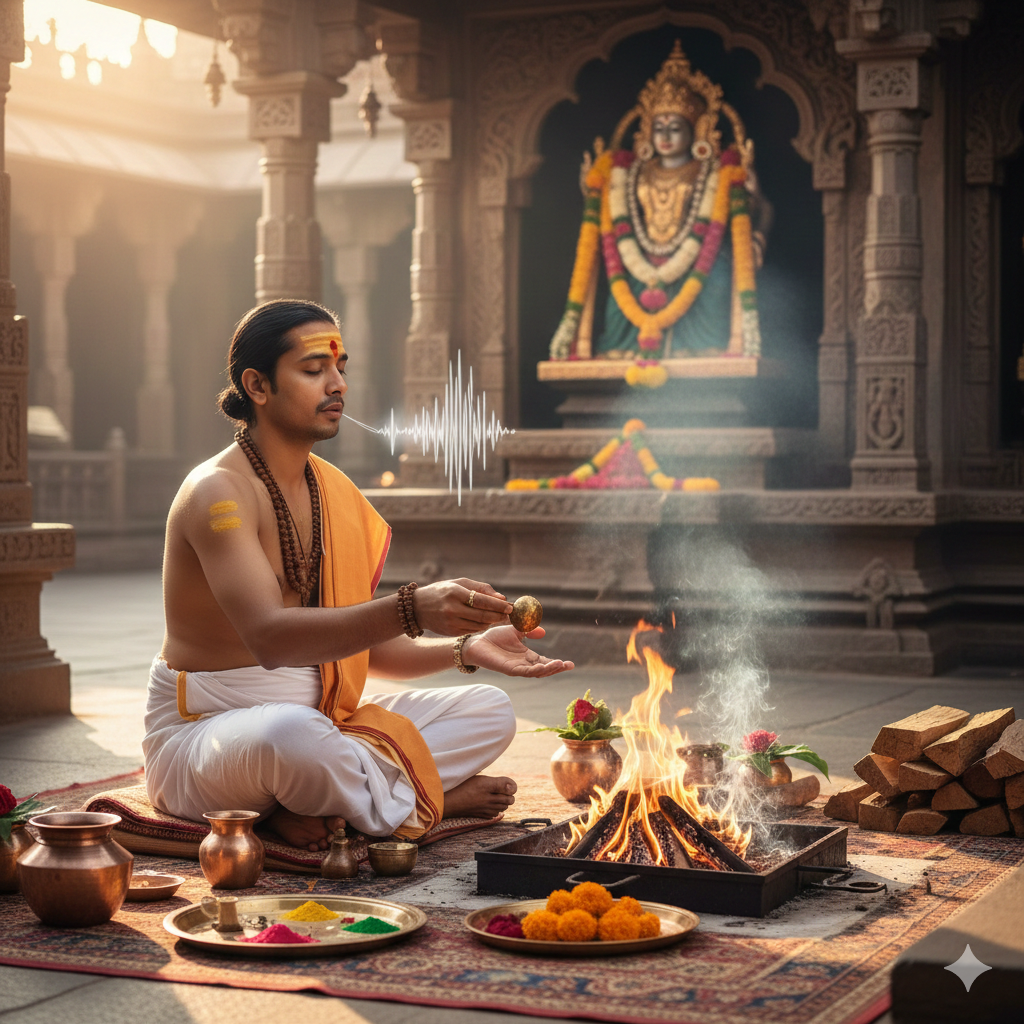
- Daily Worship and Rituals: Every puja, mantra, or homa traditionally begins and ends with Om. This sanctifies the act and ensures that it is in harmony with the cosmic vibration.
Through such simple yet powerful practices, Om becomes not just a philosophy to read about, but a living experience woven into the fabric of daily life.
Om and Its Spiritual Meaning
Om is more than just a sound; it is described in the Mandukya Upanishad as the symbol of the entire universe and consciousness. The three parts of A-U-M represent our three states of life: waking, dreaming, and deep sleep. The silence after chanting Om points to the fourth state, called Turiya- pure awareness, beyond time and space. In this way, Om connects the individual soul (Atman) with the Supreme (Brahman).
Modern research has also shown why Om feels so powerful:
Calms the brain: A study in Bengaluru found that chanting Om reduces activity in parts of the brain linked to stress and fear, creating a natural state of peace.
Balances the nervous system: When people chant Om, their heartbeat and breathing slow down, showing more relaxation and balance in the body.
Stimulates healing: Scientists explain that the humming vibration of Om may stimulate the vagus nerve, which is linked to better mood, digestion, and overall wellbeing.
So, what sages explained as Om being the path to inner peace and union with the Divine, science now shows as a sound that truly soothes the body, focuses the mind, and uplifts the spirit.
Om and the Science of Vibration
Ancient seers described Om as Nada Brahma, “the universe is sound.” Modern science, too, is beginning to uncover how vibration shapes matter, energy, and consciousness.
- Nada Yoga (Yoga of Sound): Yogic philosophy teaches that all creation arises from vibration. Chanting Om attunes the seeker to the Anahata Nada- the “unstruck sound” heard in deep meditation, symbolizing the eternal pulse of existence.
- Resonance and Healing: Science shows that sound vibrations can influence brain waves, heart rhythm, and cellular harmony. The deep humming of Om produces a resonance that relaxes the nervous system and fosters balance in body and mind.
- The Cosmic Echo: Physicists have described the “cosmic microwave background radiation”- a faint vibration that fills the universe, considered a remnant of the Big Bang. Many liken this universal hum to the eternal sound of Om, suggesting a poetic bridge between spirituality and cosmology.
Thus, Om is both an ancient spiritual practice and a timeless truth reflected in modern science: the recognition that vibration is at the heart of all creation.
Benefits of Chanting Om
Chanting Om is considered one of the most powerful practices in Hinduism and Yoga. Its vibration works on many levels of our being, from the body to the soul.
Emotional Benefits
- Reduces feelings of stress and anxiety.
- Creates a sense of inner calm and stability.
- Helps release negative emotions and brings positivity.
Physical Benefits
- Slows down heart rate and breathing, improving relaxation.
- The vibration stimulates the vagus nerve, supporting better immunity and digestion.
- Improves oxygen flow and energizes the body.
Mental Benefits
- Sharpens focus and concentration.
- Helps quiet restless thoughts, aiding in meditation.
- Balances the two hemispheres of the brain, improving clarity and memory.
Spiritual Benefits
- Connects the soul (Atman) with the Supreme (Brahman).
- Awakens higher states of consciousness described in the Upanishads.
- Brings a sense of oneness with the universe, guiding the seeker towards liberation (moksha).
Thus, chanting Om is not just a ritual, it is a complete practice that heals the body, calms the mind, balances emotions, and uplifts the spirit.
How the Om Symbol (ॐ) Evolved
While Om is first and foremost a sound vibration, its written form ॐ has also become one of the most recognizable spiritual symbols in the world. The journey of this symbol has deep historical and cultural roots.
Early Manuscripts: In the earliest Vedic texts, Om was written simply in phonetic form as “Om” or “Aum.” It was a sound to be recited, more than a visual emblem.
Classical Sanskrit: Over time, as Sanskrit writing evolved, the syllable was stylized. Ancient scripts like Brahmi and Grantha began showing symbolic marks that represented Om, bridging sound and script.
Devanagari Form: The familiar design ॐ, as we see today, became standardized with the rise of the Devanagari script. Its graceful curves are not decorative; each part corresponds to a philosophical truth.
- The large lower curve represents the waking state (jagrat).
- The middle curve represents the dream state (swapna).
- The upper curve signifies deep sleep (sushupti).
The crescent with the dot above represents turiya, the transcendent state of pure consciousness.
Thus, the symbol is not just a calligraphic design but a visual map of consciousness itself. Chanting Om awakens the vibration; seeing ॐ awakens the understanding. Together, they form a complete spiritual practice for mind, body, and soul.
-in-Astrology.jpg)
.jpg)


Comments 0
Leave your thought here