

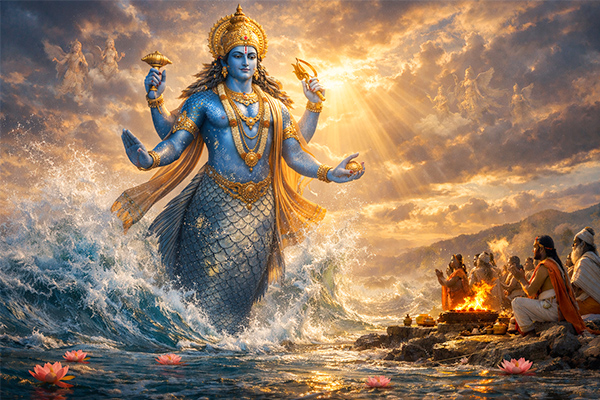
Matsya Jayanti, a sacred occasion commemorating the divine incarnation of Bhagwan Vishnu as Matsya, the cosmic fish, is a day of immense spiritual significance, symbolizing divine intervention, protection, and the preservation of dharma. Falling on Saturday, March 21, 2026 , this auspicious day is observed with deep devotion, fasting, and prayers, as devotees seek the blessings of Bhagwan Vishnu for wisdom, guidance, and liberation from ignorance. The Matsya Avatar, appearing at the dawn of creation, signifies the triumph of righteousness over chaos, reminding devotees of the Bhagwan’s eternal presence in guiding and safeguarding His creation. Through sacred rituals, recitation of Vishnu Stotras, and meditation, this day inspires spiritual renewal, purity of heart, and steadfast faith in the divine cosmic order.
Festival Date, Time, Muhurat & Tithi
Matsya Jayanti will be observed on Saturday, March 21, 2026.
Chaturthi Tithi (4th lunar day) of the Chaitra month as per the lunar calendar.
Key Timings for Matsya Jayanti 2026:
Matsya Jayanti Muhurat - 01:59 PM to 04:24 PM
Duration - 02 Hours 26 Mins
Tritiya Tithi Begins - 02:30 AM on Mar 21, 2026
Tritiya Tithi Ends - 11:56 PM on Mar 21, 2026
Note: Sunrise and sunset vary by region and date due to India's geographical diversity. For exact timings, refer to local astronomical data.
Significance & Story of Matsya Jayanti
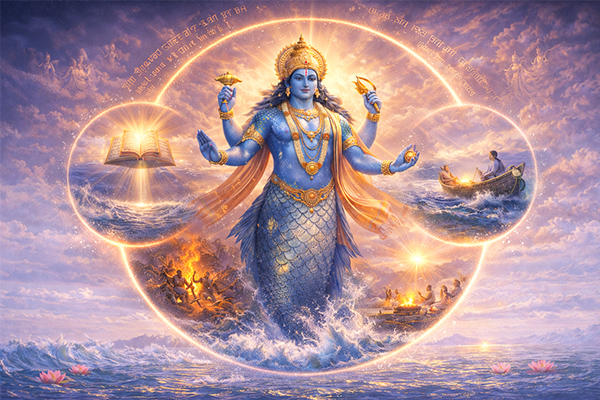
Matsya Jayanti, a sacred celebration of Bhagwan Vishnu’s first divine incarnation as Matsya , the cosmic fish, symbolizes divine protection, the preservation of dharma, and the eternal guidance of the Divine in times of crisis. Observed on the third day of the waxing moon in the month of Chaitra, this auspicious occasion signifies the Bhagwan’s role in rescuing the Vedas and guiding humanity through the cosmic deluge, ensuring the triumph of wisdom over ignorance and righteousness over chaos. The Matsya Avatar represents the profound truth that in every age, Bhagwan Vishnu manifests to uphold dharma and safeguard creation from destruction, reminding devotees of the omnipresence of the Divine in the unfolding cosmic order.
All the Vedic scriptures praise and sing the glory of Bhagwan Vishnu, considering Him to be the ultimate beneficiary of all the sacrifices (prayers) offered. The Bhagwan takes different avatars (incarnations) and descends to perform superhuman acts and pastimes in order to attract His devotees and other saintly humans. There are two objectives behind the appearance of Bhagwan Vishnu in His different avatars. First, He attracts and protects His devotees and recalls the fallen souls. Second, He destroys the evil forces that threaten the pious and the existence of the cosmos.
The Bhagwan reveals His purpose for descending onto Earth in the Bhagavad Gita (4.7-8): yadā yadā hi dharmasya glānir bhavati bhārata abhyutthānam adharmasya tadātmānaṁ sṛjāmy aham (4.7) paritrāṇāya sādhūnāṁ vināśāya ca duṣkṛtām dharma-saṁsthāpanārthāya sambhavāmi yuge yuge (4.8)
“Whenever and wherever there is a decline in religious practice, O descendant of Bharata, and a predominant rise of irreligion—at that time I descend Myself.” (4.7) “To deliver the pious and to annihilate the miscreants, as well as to reestablish the principles of religion, I myself appear—millennium after millennium.” (4.8)
The aforementioned verses unambiguously reveal the divine missions. Millennium after millennium signifies that it’s a continuous process. Evil forces keep creating the disturbances. Devotees always pray to the Bhagwan to save the innocent from such forces. Their prayers please the Bhagwan, who incarnates in His divine avatars to fulfill His missions.
The Vedas inform that the Bhagwan incarnates onto various lokas (planets) from time to time. The scriptures assert that the Bhagwan manifests innumerable incarnations on planets within millions of galaxies. The pious celebrate, sing, or pray to His ten most popular incarnations in this material world (our universe). Following are the ten most popular incarnations of Vishnu, called Dashavatara. Dasha means ‘ten,’ and avatar means ‘incarnation.’. And one of the incarnations is Fish or Matsya Avatara.
Matsya Avatara: This is the fish incarnation of Vishnu. He once rescued Manu and the mighty Seven Sages ‘saptarshi’ (Kaśyapa, Atri, Vasiṣṭha, Viśvāmitra, Gautama, Jamadagni, and Bharadvāja) from pralaya (the Great Flood or Deluge). In this form, the Bhagwan had a human torso connected to the rear half of a fish. The Puranas recount that the Bhagwan warned Manu and other sages about the Great Flood. The Sages instructed Manu to board a boat, accompanied by all the species of life, including grains. While they were crossing the flood, it was Bhagwan Matsya who protected them. The Flood is a period of no activities (material or spiritual) between two creations.
The observance of Matsya Jayanti is a time for deep spiritual reflection, fasting, and devotion, as seekers turn to Bhagwan Vishnu for guidance, wisdom, and inner purification. By engaging in sacred rituals, chanting Vishnu Stotras, and meditating on the divine leelas of Matsya Avatar, devotees realign themselves with the path of righteousness, cultivating faith, discipline, and surrender.
This sacred occasion is not merely a commemoration of a divine event but an invitation to embark on a spiritual journey, awakening the soul to the realization that true salvation lies in unwavering devotion and complete surrender to the Divine. Through sincere prayers and self-discipline, one invokes Bhagwan Vishnu’s boundless grace, seeking divine protection, inner transformation, and the ultimate liberation of the soul.
How to celebrate Matsya Jayanti
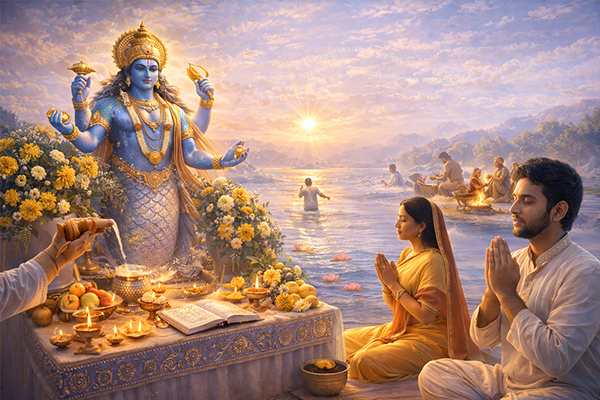
Matsya Jayanti, a sacred celebration of Bhagwan Vishnu’s first divine incarnation as Matsya, is observed with deep devotion, reflection, and spiritual discipline.
The day begins with a holy bath (snan) before sunrise, symbolizing inner and outer purification, followed by a heartfelt sankalp (vow) to observe the vrat (fast) with sincerity. Devotees adorn their homes and temples with fresh flowers, offer tulsi leaves, yellow flowers, fruits, and panchamrit in worship, and light lamps to honor Bhagwan Vishnu.
The air resonates with the chanting of Vishnu Sahasranama and recitations from the Matsya Purana, recounting the divine leela of how Vishnu, in His fish incarnation, rescued the sacred Vedas and guided humanity through the great deluge. Many visit temples to offer prayers, while others create an altar at home, immersing themselves in bhajans, kirtans, and meditative worship, strengthening their bond with the Divine.
Fasting on Matsya Jayanti is believed to be spiritually transformative, purifying the mind and soul while invoking Bhagwan Vishnu’s divine protection. Devotees observe nirjala vrat (fasting without water) or phalahar vrat (consuming only fruits and milk), dedicating the day to prayer and self-discipline. Rituals include deep daan (offering lamps), havan (fire sacrifice), and acts of charity (daan-dharma), symbolizing detachment from worldly distractions and devotion to the Supreme.
The Matsya Avatar katha is recited with devotion, reminding devotees of Vishnu’s eternal presence as the preserver of dharma. As the sacred verses fill the air, hearts are uplifted, reinforcing the belief that faith, discipline, and surrender to the Divine lead to true victory over adversity and ignorance.
Beyond rituals, Matsya Jayanti inspires a deeper spiritual awakening, reminding devotees that Bhagwan Vishnu always manifests to guide and protect those who walk the path of righteousness. It is a day to cultivate selfless service (seva), patience, and unwavering faith, knowing that divine grace is ever-present.
Many engage in japa (chanting 'Om Namo Narayanaya') and meditation, seeking inner peace and clarity. As the evening aarti fills the air with divine vibrations, prasad is distributed, and devotees experience a renewed sense of spiritual strength, hope, and connection with Bhagwan Vishnu.
The celebration of Matsya Jayanti is not just a ritual-it is an invitation to trust in the Divine’s plan, navigate life’s challenges with courage, and ultimately move toward moksha (liberation).
Matsya Jayanti Festival Puja Vidhi (Puja Procedure)
_209858.jpg)
Rrituals performed on Matsya Jayanti symbolize surrender to the Divine and reaffirm faith in Bhagwan Vishnu’s eternal guidance.
- Purification and Sankalp: The puja begins with an early morning snan (holy bath), signifying inner and outer purification. Devotees wear clean, preferably yellow clothes, and take a sankalp (sacred vow) to observe the vrat (fast) with sincerity, seeking Bhagwan Vishnu’s blessings for spiritual growth, wisdom, and protection from negativity.
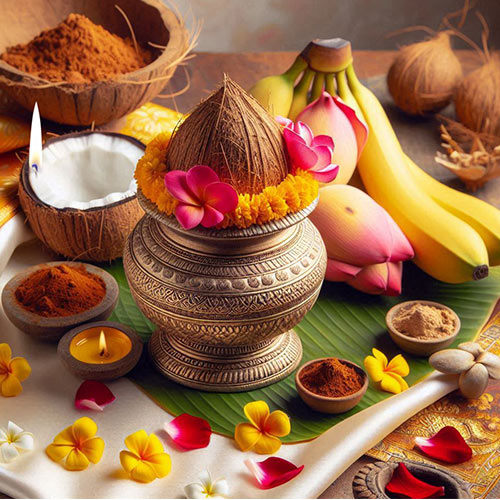
- Preparation of the Puja Altar: A clean and sacred space is arranged with an idol or image of Bhagwan Matsya or Vishnu, placed on a decorated altar. The altar is adorned with tulsi leaves, yellow flowers, a kalash (sacred water vessel), diyas (lamps), and incense. Fresh fruits, coconut, and sweets are also placed as offerings.
- Invocation and Offerings: The puja starts with Dhyana (meditation) and the invocation of Bhagwan Matsya by lighting a ghee or oil diya. Devotees offer tulsi leaves, yellow flowers, fruits, coconut, and panchamrit (a sacred mixture of milk, honey, ghee, sugar, and yogurt) while chanting “Om Namo Narayanaya” to invoke divine blessings.
- Recitation of Matsya Purana and Mantras: The Matsya Avatar Katha from the Matsya Purana is read, recounting how Bhagwan Vishnu, in His fish form, saved the sacred scriptures and guided humanity. Devotees chant powerful Vishnu mantras like: “Om Matsyaya Namah” – invoking Bhagwan Matsya’s blessings. “Om Namo Bhagavate Vasudevaya” – seeking spiritual upliftment and divine grace.
- Aarti and Deep Daan: Aarti is performed using camphor or a ghee lamp, accompanied by the singing of Vishnu Aarti, signifying the removal of ignorance and the arrival of divine wisdom. Afterward, deep daan (offering of lamps) is done by placing diyas near the Tulsi plant or in water bodies, symbolizing surrender to Bhagwan Vishnu’s divine light.
- Fasting and Charity (Seva and Daan): Fasting on Matsya Jayanti is highly auspicious, with devotees observing nirjala vrat (fast without water) or phalahar vrat (consuming only fruits and milk). The day is also marked by charitable acts, such as donating food, clothes, and essentials to the needy, feeding cows, and helping the underprivileged, as acts of seva (selfless service).
- Prasad Distribution and Conclusion of Puja: After the puja, prasad, including panchamrit and fruits, is distributed among family members and devotees. The day is concluded with meditation, japa (chanting Vishnu mantras), and scriptural readings to deepen one’s connection with Bhagwan Vishnu. The puja ends with a prayer for divine protection, inner peace, and ultimate liberation.
Matsya Jayanti is a spiritual opportunity to align with Bhagwan Vishnu’s divine energy, seeking His guidance in navigating the challenges of life. Through fasting, prayers, and devotion, devotees reaffirm their faith in dharma and embrace the eternal truth that Bhagwan Vishnu always protects those who surrender to Him. Observing Matsya Jayanti with sincerity brings wisdom, purity, and spiritual elevation, leading the devotee toward the ultimate goal of moksha (liberation).
Matsya Jayanti Puja Mantras
Matsya Avatar Mantra
'Om Matsyaya Namah'
Meaning: I bow to Bhagwan Matsya, the divine fish incarnation of Vishnu, who saves and protects dharma.
Matsya Gayatri Mantra (For Divine Protection and Knowledge)
'Om Matsyarupaya Vidmahe Mahameenaya Dhimahi
Tanno Vishnuh Prachodayat.'
Meaning: May we meditate on the divine form of Bhagwan Vishnu as Matsya. May He illuminate our intellect and guide us toward righteousness.
Matsya Jayanti Aarti Mantra
'Jai Matsya Bhagwan, Jai Jagat Ke Swami
Jai Jai Govind Hari, Bhakt Vatsal Swami.'
Meaning: Glory to Bhagwan Matsya, the protector of the universe. Glory to Govind Hari, the compassionate savior of His devotees.
Matsya Jayanti Vrat Vidhi (Fasting Procedure)
_209860.jpg)
Purification and Sankalp: The vrat begins with an early morning snan (ritual bath) for inner and outer purification.
- Devotees wear clean, preferably yellow clothes and sit in a sacred space.
- A sankalp (vow) is taken before Bhagwan Vishnu or Matsya Avatar, praying for spiritual progress, removal of sins, and divine protection.
Types of Fasting
- Nirjala Vrat: Complete fast without food or water (for those who can endure).
- Phalahar Vrat: Fasting with fruits, milk, and sattvic food (without grains, onion, or garlic).
The fast is observed throughout the day, maintaining purity in thoughts, words, and actions.
Puja and Worship
- Devotees offer tulsi leaves, yellow flowers, panchamrit, fruits, and sweets to Bhagwan Vishnu.
- Chanting of Vishnu Sahasranama, Matsya Purana, and Matsya Jayanti katha is performed.
- The puja concludes with aarti and deep daan (offering of lamps), symbolizing surrender to the Divine.
Engagement in Spiritual Activities
- Devotees spend the day in bhajans, kirtans, mantra chanting, and meditation.
- Japa of 'Om Namo Bhagavate Vasudevaya' is performed for spiritual upliftment.
- Acts of selfless service (seva) and charity (daan) enhance the benefits of the vrat.
Breaking the Fast: The fast is broken in the evening after offering prayers.
Charity and Daan: Donating food, clothes, and essentials to the needy is highly meritorious. Feeding cows, Brahmins, and the poor brings blessings of Bhagwan Vishnu.
Matsya Jayanti vrat purifies the mind and soul, removes past sins, and brings divine blessings. By observing this vrat with faith and devotion, devotees seek inner strength, guidance, and moksha (liberation).
Matsya Jayanti Vrat Katha (Traditional Fasting Story)
_209859.jpg)
In the ancient era of Satya Yuga, when the universe was brimming with righteousness but also witnessing the rise of darkness, a great cosmic event unfolded—one that would mark Bhagwan Vishnu’s divine intervention as Matsya Avatar. Among the noble rulers of that time was King Satyavrata, a devout and virtuous monarch known for his unwavering faith and deep devotion to Bhagwan Vishnu. His heart was filled with compassion, and his mind constantly engaged in the pursuit of dharma.
One day, as Satyavrata performed his morning prayers on the sacred banks of a river, he noticed a tiny fish struggling in the water, gasping for life. Moved by kindness, he gently lifted it and placed it in his kamandalu (holy water pot) to protect it. To his astonishment, within moments, the fish began to grow. Seeing this, he transferred it to a larger vessel, but the fish continued expanding. He then placed it in a pond, yet the fish outgrew that too. With each passing moment, it grew exponentially, soon outgrowing even the mighty ocean itself.
As Satyavrata stood in awe, trying to comprehend this miraculous event, Bhagwan Vishnu revealed His divine form as Matsya, His eyes filled with cosmic wisdom and boundless compassion. His resplendent form shone with the brilliance of a thousand suns, His voice echoing like thunder through the heavens. Bhagwan Matsya spoke, revealing to the king an impending pralaya (great deluge), which would soon engulf the entire earth in its powerful waves. He instructed Satyavrata to construct a massive boat and gather within it the seven great sages (Saptarishis), sacred seeds of all plants, and pairs of every living species so that life could be preserved beyond the destruction.
As the apocalyptic flood descended upon the world, Bhagwan Matsya grew into an immense celestial fish, His body spanning across the cosmic waters. With His divine power, He tied the great boat to His horn using Vasuki, the divine serpent, and navigated through the tumultuous waves. Amidst the swirling chaos, Bhagwan Vishnu imparted to Satyavrata and the Saptarishis the sacred wisdom of the Vedas, ensuring that divine knowledge would never be lost, even in the face of total annihilation. His voice resonated through the heavens, reminding all that dharma is eternal, and those who seek refuge in Him will always be protected.
As the floodwaters finally receded, the boat came to rest on the holy Mount Meru, where life began anew under the divine guidance of King Satyavrata and the enlightened sages. Thus, the great cycle of creation continued, and Bhagwan Vishnu’s boundless grace ensured that righteousness prevailed over chaos. The Matsya Avatar stood as a symbol of divine protection, wisdom, and the unbreakable promise that Bhagwan Vishnu would always descend to uphold dharma and safeguard His devotees.
Significance of Observing Matsya Jayanti Vrat
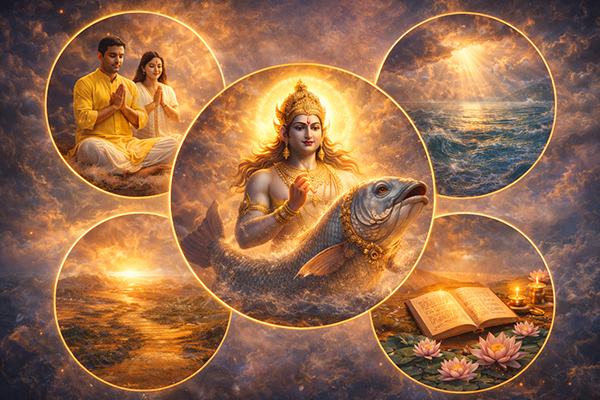
The Matsya Jayanti Vrat is a sacred observance that connects devotees to this timeless story of divine intervention, faith, and renewal. Fasting on this day purifies the soul, removes accumulated sins, and grants divine blessings, just as Bhagwan Vishnu’s presence guided the world through the great deluge. Observing the vrat with devotion reminds us that no storm in life is too great when we surrender to the Supreme. Through faith, discipline, and righteousness, one finds protection, spiritual awakening, and the path to moksha (liberation).
As we commemorate Matsya Jayanti, let us reflect on this divine leela, embracing the eternal truth that Bhagwan Vishnu’s grace is ever-present, unwavering, and all-encompassing. Just as He rescued the sacred scriptures and guided the world through darkness, He continues to guide each of us through the ocean of life, leading us toward the ultimate shore of enlightenment and liberation.
Puja Utensils, Essentials

Rudra Centre brings an extensive collection of Puja Articles which caters to all that is required for daily and special Puja Vidhis. We offer variants of designs and sizes in each category. The list includes handcrafted Puja Mandirs, Puja Pedestals, offering Bowls, Panchpatra, intricately carved Puja Thalis, Abhishek Vessels, in different materials, Pure Silver/German Silver articles like Kalash, set of Shodash Upachara and Several other Puja Articles, which we deliver at your doorstep.
Matsya Yantra
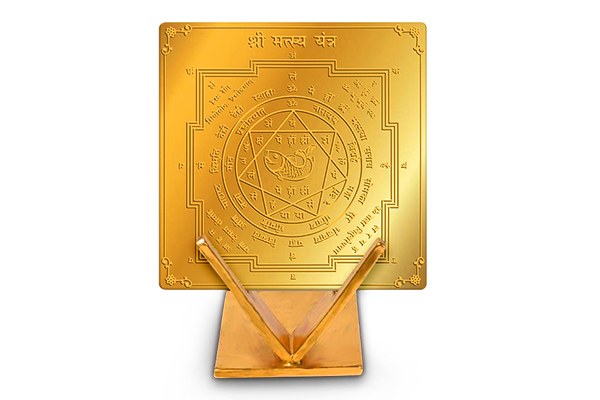
Matsya Yantra represents the Matsya (Fish) Avatar of Bhagawan Vishnu, who incarnated in this form to save the world and purify the cosmos for perfect balance and harmony. Similarly, the Matsya Yantra provides protection to your home or workplace and removes all kinds of negative influences in the dwelling and its surroundings. Matsya Yantra is also recommended for removing all kinds of Vastu faults.
Tulsi Malas

Visit our exclusive collection
Explore a fine range of Natural Tulsi Malas made from Original Tulsi wood. Our collection includes Round, Cylindrical, Drum or Lingam Shape, Carved White & Black Tulsi Beads in Thread, Silver, Copper & Gold crafted by our in-house team of traditional Indian artisans. Our Tulsi Malas can be used for wearing as well as Japa Mantra chanting.
19 Mukhi (Face) Nepali Rudraksha
-Nepali-Rudraksha_209854.jpg)
The original 19 mukhi rudraksha holds the powers of Lord Narayana and it blesses the wearer with good health, success in all undertakings, immense wealth, and abundance in all spheres. The wearer of the rare 19 mukhi rudraksha bead is blessed with beauty, many virtues, prosperity, and power to fulfil desires along with many virtues by Lord Vishnu and Goddess Laxmi.
Vishnu Puja
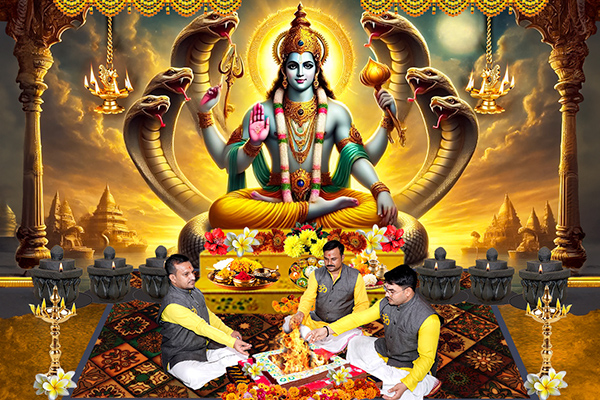
The purpose of performing the Anant Vishnu Puja is to attain blessing of Bhagwan Anant Vishnu and to blessed by materialistic comforts, peace of mind and happiness. This divine form of Bhagwan Vishnu is also worshipped to regain lost wealth. The Vaishnavites, revere Him as the Supreme deity, one who has no beginning and no end.
The benefits of performing the Anant Vishnu puja is as follows:
- Offers divine blessings of Bhagwan Vishnu
- Offers divine blessings of Goddess Lakshmi
- Invites riches and prosperity
- Offers success and growth in all undertakings
- Helps to recover lost wealth
- Offers overall abundance
- Offers contentment and bliss
- Offers protection from negative energies and evil spirits
- Fills life with happiness
Rudra Centre Puja Services is the oldest and most trusted Online Puja Services provider in the world. Over 20 years we have organized Yagnas, Pujas, Homas and Kathas like Ati Rudra Mahayajna, Sahasra Chandi Homa, Akhand Ramayan Paath, Shiva Maha Puran Katha, 4 Prahar Mahashivratri Mahapuja with teams of 100’s of curated priests for the benefit of mankind and our global clientele.
Conclusion
Matsya Jayanti is a divine revelation, a cosmic reminder that Bhagwan Vishnu, the eternal preserver, manifests whenever dharma wavers, darkness spreads, and chaos threatens creation. The sacred leela of Matsya Avatar embodies the unshakable promise of divine protection, wisdom, and restoration, assuring devotees that no matter how turbulent the ocean of life may seem, Bhagwan Vishnu’s grace will always guide them to safety. Just as He rescued the Vedas and safeguarded humanity from the great deluge, He continues to illuminate the path for those who surrender to Him with unwavering devotion.
Observing Matsya Jayanti Vrat is a sacred bridge between the soul and the Divine, an opportunity to cleanse one’s karma, strengthen spiritual resolve, and experience the profound tranquility that comes with true surrender. This sacred day is a call to rise above worldly distractions, cultivate devotion, and embark on the ultimate journey, toward moksha, the eternal union with the Divine. Through faith, humility, and unwavering surrender, one discovers the boundless ocean of Bhagwan Vishnu’s love, where the soul finds its ultimate refuge and fulfillment.
-in-Astrology.jpg)
.jpg)


Comments 0
Leave your thought here