

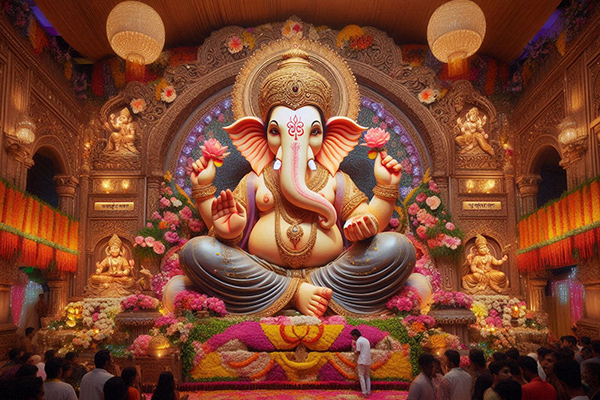
Anant Chaturdashi, also known as Chaturthi, is an auspicious festival celebrated by Hindus and Jains with high positive vibrations. It marks the final day of the ten-day Ganeshotsav or Ganesh Chaturthi and is called Ganesh Chaudas, when devotees bid farewell to Bhagwan Ganesha through the Anant Chaturdashi Ganesh Visarjan. This sacred day is also dedicated to Bhagwan Vishnu, worshipped in His Anant (Infinite) form. Devotees commonly observe the Anant Vrat (fast) to cleanse themselves of karmic reactions, sorrows, and sufferings. The term ‘Anant’ means ‘endless,’ and Vishnu's reclining posture represents spiritual rest as the form of Narayana before the creation of the Cosmos.
Anant Chaturdashi 2026 Date and Time
Every year Anant Chaturthi or Anant Chaudas falls on Chaturdashi or the fourteenth day of the Shukla Paksha (waxing moon phase) of Bhadrapada month.
Anant Chaturdashi
on Friday, September 25, 2026
Anant Chaturdashi Puja Muhurat -
06:28 AM to 11:06 PM
Duration -
16 Hours 38 Mins
Chaturdashi Tithi Begins -
11:18 PM on Sep 24, 2026
Chaturdashi Tithi Ends -
11:06 PM on Sep 25, 2026
On Anant Chaturdashi, devotees perform Anant puja at an auspicious time.
Significance of Anant Chaturdashi
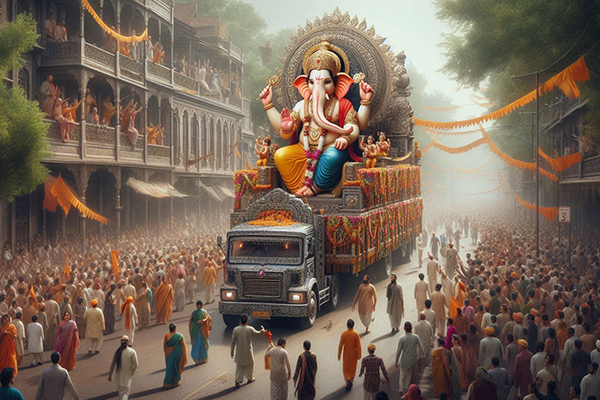
Anant Chaturdashi holds great significance as it unites major Hindu and Jain observances, creating a day of immense spiritual energy. For Hindus, it is dedicated to Bhagwan Vishnu in His form as Ananta, resting in Yoga Nidra upon Sheshnaga. This symbolizes balance and steadiness, teaching devotees to remain unmoved by joy or sorrow while staying aware of higher truth. Sheshnaga is also honored for his eternal service to the Divine. Devotees observe the Anant Vrat, tying the sacred Anant Daram thread on their arm while seeking restoration of wealth, harmony, and blessings. Alongside this, the day also symbolizes the connection with Bhagwan Ganesha, whose body represents the temple of the soul that must eventually merge into Paramatma. On Anant Chaturdashi, His idols are immersed in water bodies, marking His spiritual return to the cosmic realm and reminding devotees of the soul's journey back to the Supreme.
In Maharashtra, Ganesh Utsav is the most important festival, with celebrations lasting ten days and concluding on Anant Chaturdashi. On this day, devotees bid farewell to Ganapati Bappa with the grand ritual of Ganesh Visarjan. Before immersion, families and communities perform Aarti and the Anant Puja, expressing devotion and gratitude. Though the departure of the beloved deity fills hearts with emotion, devotees joyfully invite Him to return the following year, chanting in unison with faith and devotion. The immersion becomes not an end, but a reminder of spiritual continuity and the eternal presence of the divine.
Significance in Jainism
For Jains, Anant Chaturdashi holds deep spiritual importance as it marks the Nirvana of the twelfth Tirthankara, Bhagwan Vasupujya. For the Digambara sect, it also signifies the conclusion of the ten day observance of Paryushana in the month of Bhadrapada, making Anant Chaturdashi its final and most significant day. The following day, Kshamavani, is observed as the day of forgiveness when Jains seek pardon for any intentional or unintentional mistakes. With its convergence of these major observances, Anant Chaturdashi becomes a profoundly auspicious occasion, granting great spiritual merit to those who engage in fasting, prayer, and devotion.
Celebration of Anant Chaturdashi in Northern India and Puja Vidhi
People from Bihar and eastern regions of Uttar Pradesh, on the pious Anant Chaturdashi date, worship the Kshirsagara, the Ocean of Milk and Ananta, the divine form of Bhagwan Vishnu. Anant pooja is performed by the devotees by following the Anant Chaturdashi Puja Vidhi to get the blessings of Bhagwan Vishnu.
- On Anant Chaturdashi, the families perform this puja Vidhi with devotion and faith. The puja samagri is kept ready before the Anant Chaturdashi day. On the Anant Chaudas, the devotees make 14 long 'tilaks' with Kumkum or vermilion on a wooden plank and keep 14 puris (fried bread) and 14 Maal Puas (a deep-fried Indian sweet bread) on the 14 tilaks.
- Following this, the family members take a bowl filled with Panchamrit (a mix of milk, curd, jaggery, honey, and ghee) and keep it on the wooden plank. This mix denotes the Divine Ocean of Milk, the Kshirsagara, in the Anant Chaturdashi Puja Vidhi.
- They then take a thread with fourteen knots, meaning Bhagwan Anant, bound on a Cucumber which is twirled five times in the Panchamrit or Ocean of Milk. This thread is like a Raksha Sutra or a protective thread, which protects from evil.
- After completion of Anand Chaudas, men tie this Ananta thread on their right arm under the sleeve and women tie their left arm. The Ananta thread is worn for a period of 14 days and then this thread is removed.
- Women keep Anant vrat. Chaturdashi vrat is kept for the good health and well-being of family members. Men keep Anant vrat for wealth and prosperity. Devotees keep the Anant vrat for 14 years, once started. The 14 years period find an explanation in the Anant Chaturdashi Vrat Katha.
Anant Chaturdashi Vrat Katha
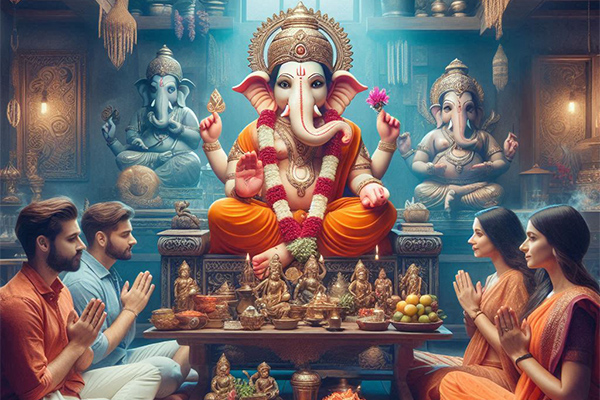
The Anant Chaudas ki Katha or story is about the Anant vow. This Vrat Katha is read or heard on the day of Anant Chaudas by people observing the vrat.
It is a story of Sushila and Kayndinya. After being troubled by her stepmother, Sushila left her father Suman (a Brahmin), and along with her husband Kaundinya, she moved on.
Along the way to the forest, they stopped by a river for a bath. While Kaundinya bathed, Sushila went a bit away and saw a group of women worshipping Bhagwan Anant. One of them explained the rituals that included the offering of gharha and anarase, sacred food along with flowers, oil lamps, and incense sticks to the Bhagwan as well as a silk string (known as Anant) kept at the altar and then worn on the arm as is mentioned in the Anant Chaturdashi story.
Anant Chaturdashi Katha goes on to say that soon Sushila followed the Anant pooja rituals and prosperity made its way into their life until Kaundinya observed the Ananta string on her arm. When asked by her husband, Sushila narrated about the Anant puja and how it had brought in the prosperity. However, Kaundinya did not like his wife's belief about the Ananta thread and Anant puja. He told her that prosperity and success are due to one's intelligence and never due to some ritual, he took the string off her arm and discarded it.
This act was the cause of the misery and poverty which ensued, making Kaundinya realize his mistake. Anant Chaturdashi Katha goes on to say that to atone for dishonoring Bhagwan Ananta, he went into the forest for Tapasya and asked anyone or anything along the way if they had seen an Ananta string. A worm-filled Mango tree said 'No'. Then he saw a cow with her calf, a bull standing on the grass without grazing. Further, he saw two lakes adjacent to each other with their waters mixing. Later, he saw a donkey and an elephant. None of them had seen the Ananta string.
The Anant Chaturdashi Katha takes a dramatic turn here, as overwhelmed with grief, Kaundinya thought of hanging himself. An aged Brahmin stopped him and removed the rope from Kaundinya's neck. He took him to a cave nearby. Moving into the cave, he saw darkness. Walking a few steps, he saw a thing light getting bigger and bigger. There was a big palace that they entered and a massive assembly of men and women welcomed them, presided by Bhagwan Ananta Himself.
Kaundinya looked sideways and found that there was no Brahmin beside him but Bhagwan Vishnu Himself. Realizing that it was Vishnu who saved him from hanging himself, he fell down at the Bhagwan's feet and confessed his sin. Bhagwan Ananta asked him to follow a 14-year Vow to get rid of the sinful reactions and attain opulence, wealth, children, and happiness.
Later on, Bhagwan Ananta explained to him that the Mango tree was a Brahmin who possessed immense knowledge but did not share with others. The cow was Earth that had consumed all the plant seeds. The bull that personified religion stood on the field of green grass. The two lakes personified love between two sisters whose alms were spent on each other only. The donkey represented cruelty and anger and the elephant was nothing but Kaundinya's pride.
The Anant Chaudas ki Katha or Anant Chaturdashi Vrat Katha glorifies the power of Bhagwan Anant and gives us an opportunity to learn from it and proves Anant Chaturdashi's importance.
Rituals and Observances on Anant Chaturdashi
Anant Chaturdashi holds great significance with two festivals observed on the day, emphasizing its importance. The main ritual involves tying the sacred thread called Anant Daram, a fourteen-thread cotton band with fourteen knots. Women tie it on their left hand, while men tie it on their right. The fourteen knots represent the fourteen glands in the human body, and the ritual attracts the energies of Bhagwan Vishnu.
Anant Chaudas, also known as Ganesh Chaudas, is the final day of Ganesh Chaturthi and coincides with Anant Chaturdashi for Ganesh Visarjan. Devotees pray to Bhagwan Ganesha, who also worships Bhagwan Vishnu, glorifying His divinity.
Devotees observe the Anant Vrat by following the fasting and prayer rituals throughout the day from morning to evening. If strict fasting is not possible, consuming fruits once duringthe day is acceptable. Advanced devotees who dedicate themselves fully to Bhagwan Vishnu observe rigid fasting. Thousands observe this vrat with devotion.
Worship practices include visiting Bhagwan Vishnu or Krishna temples to offer prayers and perform Anant puja. If temples are not nearby, idols at home should be worshipped with sandalwood paste, flowers, fruits, and dhoop. Worshipping Vishnu Yantras on this day is highly auspicious.
Meditation on Bhagwan Vishnu using the mantra “Om Namo BhagavateVasudevaya” is encouraged. This powerful mantra was given by Sage Narada and helps focus the mind. Devotees also chant the “Hare Krishna” Maha-Mantra using Tulasi beads. Offering flowers and chanting Vishnu Sahasranamam purifies the mind and body. Playing the chant during morning routines creates a spiritually uplifting environment.
Performing the Vishnu Sahasranama Puja under the guidance of qualified Brahmins is highly recommended. The puja includes Vishnu-Lakshmi Abhishek, chanting the Vishnu mantra 1100 times, reciting the Vishnu SahasranamaStrotra, followed by Homa and Aarti.
Wearing Ten Mukhi and Nineteen Mukhi Rudraksha beads, associated with Bhagwan Krishna and Narayana, purifies the inner self and strengthens willpower. These beads protect the wearer from negative energies, evil eyes, and psychic attacks.
Charity is an important part of Anant Chaturdashi puja vidhi. Donating clothes, food grains, umbrellas, hand fans, pitchers of water, and other items to Brahmins brings meritorious blessings.
Vishnu and the Symbolism of Ananta Shesha
Worship of Bhagwan Vishnu resting on Ananta Shesha during Anant Chaudas carries profound spiritual meaning. For living beings, sleep pauses physical activity while inner functions such as breath, thought, and circulation remain active. The rest of Bhagwan Vishnu is not ordinary sleep but Yoga Nidra, a divine state beyond human or celestial comprehension. This state symbolizes the illusion of ignorance caused by Maya, under which beings remain unaware of their true spiritual nature. Unlike mortal slumber, the Yoga Nidra of Bhagwan is a manifestation of His omnipotence. Even while in repose He sustains creation, perceiving and acting beyond human limitations, and generating universes with each breath.
Ananta Shesha, limitless in essence, is an eternal expansion of Bhagwan Vishnu. He serves as the divine support for all creation, holding the worlds upon His hoods and manifesting the principle of gravitational force. His service continues even after cosmic dissolution, reflecting His boundless nature and perpetual devotion. This explains the significance of worshipping Ananta on Anant Chaturdashi, as it acknowledges both the supreme power of Bhagwan Vishnu and the eternal service of Ananta Shesha in sustaining the universes and upholding cosmic harmony.
Connection with Ganesh Chaturthi
Anant Chaturdashi 2026 marks the conclusion of the ten-day Ganesh Chaturthi festival. Devotees worship Ganesh idols throughout the festival, culminating in Anant Chaturdashi with Ganesh Visarjan, the ritual immersion of the idols in water. This symbolizes the return of Bhagwan Ganesha to the cosmic realm after blessing devotees. The day combines the spiritual teachings of balance from Bhagwan Vishnu's Ananta form with the farewell and hopeful invitation for Bhagwan Ganesha's return next year. Thus, Anant Chaturdashi serves as the grand finale that honors both deities and reinforces renewal, devotion, and spiritual growth.
Ganesh Chaturthi Puja
Shree Ganesha Puja, Mantra Japa and Yajna - 11000 chants
This puja invokes Bhagwan Ganesha, the deity of wisdom and intellect, with elaborate Vedic rituals including Kalash Sthapana, Ganesh Sahasranaam, Ganesh Gayatri mantra chanting, Ganpati Homa, and more. It ends with Ganesh Aarti and prasada distribution. Devotees receive photos, videos, and can witness the puja live. Personalized details like birth data can be included. Rudraksha and Ganesh yantra are also provided.
Basic Ganesh Puja Items
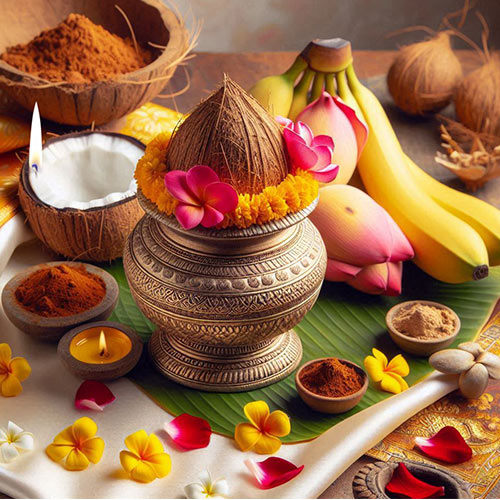
The essential items for Ganesh puja include holy water vessel, incense, oil lamps, sandalwood paste, kumkum, fresh fruits, flowers, betel leaves and nuts, camphor, milk, curd, ghee, sugar, raw rice, and a tray for offering Aarti and Naivedyam. If some items are unavailable, raw rice can substitute.
Anant Vishnu Puja
Sacred ritual honoring Bhagwan Vishnu’s infinite form, performed especially during Anant Chaturdashi. It invokes divine protection, prosperity, and spiritual upliftment through powerful mantras, abhishek, homa, and worship of Vishnu Yantra. The puja purifies karma, removes obstacles, and bestows material and spiritual blessings, including regained wealth and family harmony. Devotees also receive energized Rudraksha, tabeez, and yantra as part of the ritual. The puja is conducted live by Vedic pandits with personalized prayer for deep spiritual connection and fulfillment.
Vishnu Sahasranamam
The Vishnu Sahasranamam is the revered chant of 1,000 names of Bhagwan Vishnu, each name reflecting a divine quality. Regular recitation calms the mind, removes obstacles, and deepens spiritual devotion. It purifies the body, mind, and soul while providing divine protection and emotional healing. Chanting enhances focus, reduces stress, promotes inner peace, and supports the path to liberation. Combined with Vishnu Yantra worship, it intensifies spiritual benefits and connects devotees profoundly to the divine.
8 Mukhi Rudraksha
8 Mukhi Rudraksha is a powerful bead blessed by Bhagwan Ganesh, the remover of obstacles. It brings success, wisdom, peace, and good health while neutralizing negative influences of Rahu and Ketu. It enhances focus, clears delays, and fosters harmony in personal and professional life. Ideal for overcoming challenges and spiritual growth.
10 Mukhi Rudraksha
10 Mukhi Rudraksha is a powerful bead linked to Bhagwan Vishnu, offering protection, spiritual growth, and success. It cleanses negative energy, boosts courage, and brings harmony in relationships. It shields from misfortunes, enhances focus, and supports emotional balance. Ideal for overcoming challenges and connecting to divine energies.
19 Mukhi Rudraksha
19 Mukhi Rudraksha represents Lord Narayana and combines the blessings of Vishnu and Lakshmi. It sharpens intelligence, improves focus, and brings success in business and personal life. This rare bead offers protection, mental clarity, and spiritual growth while mitigating negative planetary effects. It supports leadership, decision-making, and overall wellbeing.
Ganesh Puja and Jaap
Powerful ritual seeking Bhagwan Ganesh's blessings to remove obstacles, dispel negative energies, and bring wisdom, prosperity, and success. It includes mantra japa, homa, abhishek, and aarti performed by experienced pandits to ensure spiritual growth and smooth progress in life. This puja helps overcome challenges and attracts good fortune.
-in-Astrology.jpg)
.jpg)


Dr Aruna Kumari B
|September 16, 2024
Great